
• TIBA (Trauma-Informed BA) articles
  • Cusp Emergence in the Community
  • About Cusp Emergence
  • About Dr. Kolu
  • ETHICS
  • Cusp Emergence University
  • Resources
  • Mentorship
  • Buffers
  • Behavioral Seismology: Predicting Behavioral Needs During Hormonal Changes

Cusp Emergence

~ Collaborating ~ Consulting ~ Constructing Repertoires

Cusp Emergence

Tag Archives: risk versus benefit analysis

NEW: Professional Development for RBTs!

Featured

Posted by kolubcbad in Uncategorized

≈ Leave a comment

Tags

bacb, BCBA, CEU, cusp emergence, Cusp Emergence University, cuspemergence-com, cuspemergenceuniversity-com, decision-making, dyad, education, ethics, kolu, PDU, professional development, professional development for dyads, RBT, risk versus benefit, risk versus benefit analysis, super5vision-ceu, supervision, supervision CEU, teresa kolu, teresa-camille-kolu, writing

(Spoiler alert: BCBAs get supervision credit too!)

A few years ago, Cusp Emergence began to notice something. The folks at my trainings were often RBTs! Registered Behavior Technicians (RBTs) are certified by the Behavior Analysis Certification Board (BACB); they work on the front lines doing some of the hardest, lowest-paid jobs in our field, and they get the brunt of the most difficult behavior. (And you know I don’t refer only to behavior emitted by clients; we all realize that staff and caregiver interactions can contribute to the most challenging parts of our work weeks).

You’d think all this makes an RBT the most respected, cared-for person in the organization. Surely they are valued like nurses, revered like clergy, paid like winning quarterbacks, and trained like the champs they are going to have to be for those marathon sessions in clients’ homes, the community, and the clinic where they are providing the majority of hours you submit to insurance for compensation.

But that’s not the case. In fact, we’re guilty of it too: Cusp Emergence University has never recorded a “for-RBTs-training”….

Until now.

That’s all changing with our new series, Professional Development for Dyads.

What’s a dyad?

A dyad is two people. Maybe the two people are related through their roles, jobs, family (like when we address a caregiver and their baby in early intervention, or a couple in a relationship). In this case, we want to address the RBT and their supervising BCBA (although each of them is welcome to take the course on their own).

Why teach RBTs to conduct Risk Versus Benefit Analysis?

Social media tempts and reinforces our behavior of crowdsourcing (and even outsourcing) our decision-making in difficult situations. In fielding or asking questions on facebook, tiktok, Instagram, or reddit, you’ve seen the following situation:

An RBT or BCBA brings up a tough situation and tries to crowd-source the answer to “what do I do?”. These are not always unique situations; many of them are familiar or someone has faced them before. And it is helpful to gain perspective if someone else has.
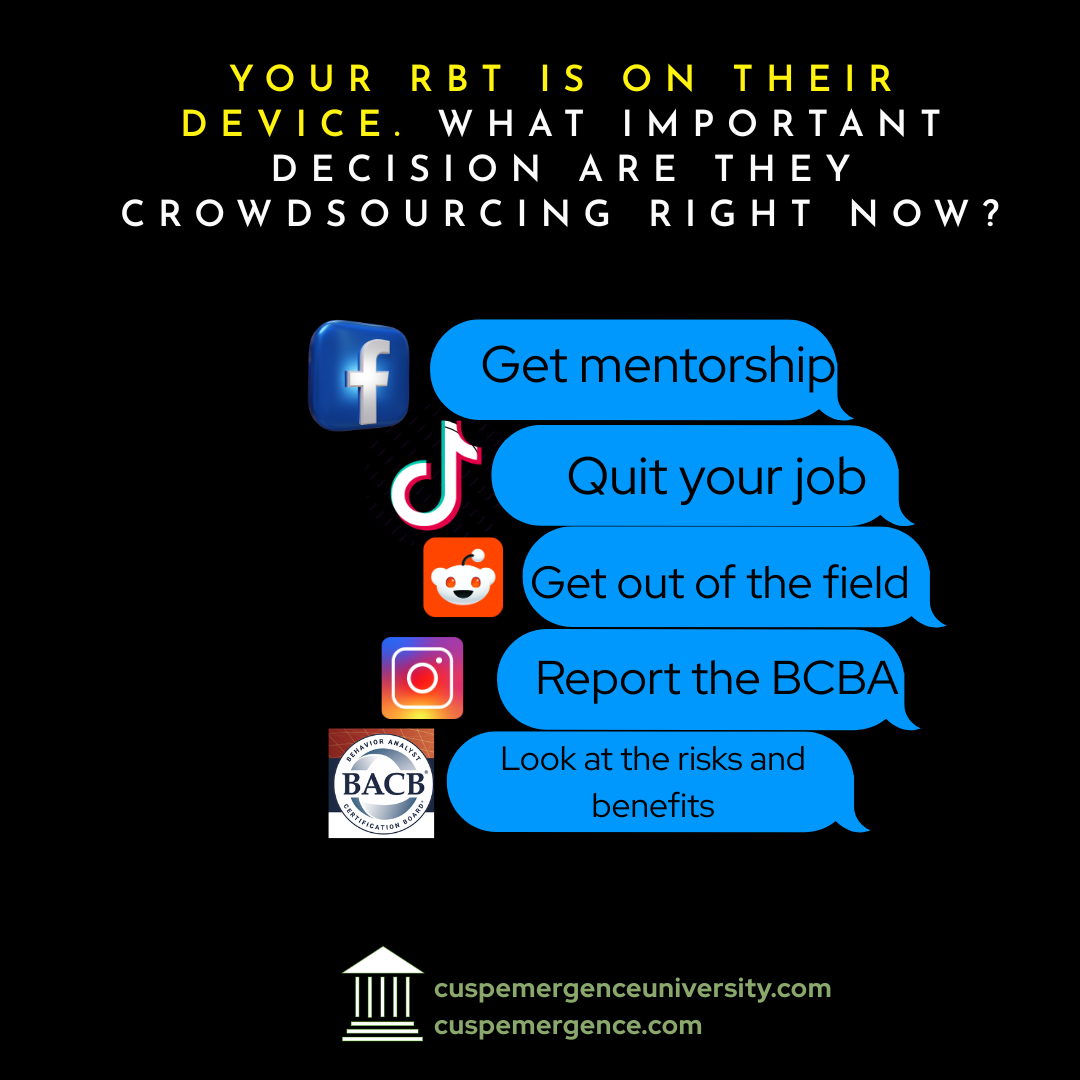
However, how many times do we vet each suggestion received, evaluate their source as credible or not, and see if there is a precedent in the literature if appropriate? How much of the time do those suggestions take into account the individualized needs of our client… while protecting their privacy and avoid sharing identifying info on social media? And how often do we actually receive advice that goes against ethics, best practice, or the law?

How is this type of course different?

  • Provides differentiated instruction: In this innovative hour with Dr. Camille Kolu, a BCBA supervisor and their RBT supervisee hear about the same topic. But level-individualized handouts provide the exercises, tools, and questions to help the RBT learn and apply new information, while the BCBA learns from a supervision perspective how to help someone else to learn skills and apply the ethics code in practical ways.
  • Uses modeling: Addressing the dyad together allows us to model supervision skills and tools for the BCBA, while the RBT gains new skills that will benefit them and their clients and team.
  • Quickly (in 1 hour) adds value to your team’s repertoire: The skills we teach in this series are all skills that are valuable for the clinician, client, and the team, and we select only skills that are most requested in our in-person trainings. The first course in the series teaches Risk Versus Benefit Analysis.

Unlike asking the internet what you should do in a tough ethical situation, conducting an individualized risk versus benefit analysis has many benefits.

The first and most obvious benefit is its outcome: doing the RVB results in several potentially satisfactory alternative options. And I love the fact that it can bring teams together, puts stimulus control over tough conversations, honors and documents voices that were not considered before, and leads to the kind of practical documentation we are asked to keep in the ethics code. (And, yes, we share a tool for that!)

So, what does this course do?

Through this 1 hour we spend together, RBTs learn many of the skills needed to encounter a behavioral cusp: completing their very own risk versus benefit assessments when faced with difficult situations.  

  • What do RBTs do in these courses? RBTs watch short videos, take quizzes, learn about ethics connections to their code, read their quiz feedback, answer thought questions, download and try out tools, and do exercises.
  • What does the supervising BCBA do? BCBAs do all of the above, but they also receive article suggestions and thought questions; notes and exercises on ethics connections, templates adapted to BCBA Ethics Code requirements, and readings and discussion questions just for them.

So where can I take this course!?

You can click on the link that’s best for you.  

  • RBTs, take this one:

https://www.cuspemergenceuniversity.com/courses/RBT-version-rvb-for-rbts

  • BCBA, take the Supervisor Version:

https://www.cuspemergenceuniversity.com/courses/Supervisor-Version-RVBs-for-RBTs

Can I gift one to my supervisor or RBT? Sure. You can always buy it as a gift for someone else in the checkout.

Can I get a group rate? Absolutely! Just select group and buy as many as you need at checkout. The group discounts will automatically apply.

Haven’t signed up for our Cusp Emergence University newsletter yet, where you’ll hear about new courses? Click here.

Have another question? I would be happy to hear from you! -Camille

← Back

Thank you for your response. ✨

Too risky to document risks?

17 Tuesday Jul 2018

Posted by kolubcbad in adults, Behavior Analysis, behavior cusp, Behavioral Cusp, boundaries of competence, collaboration, Community, Education, ethics, resources, risk analysis, risk assessment, risk versus benefit analysis, supervision, teaching behavior analysis, teaching ethics, trauma, trauma-informed behavior analysis, Uncategorized

≈ Leave a comment

Tags

ethics, risk assessment, risk management, risk versus benefit, risk versus benefit analysis, trauma, trauma-informed behavior analysis

This post is part of a series on trauma-informed behavior analysis by Dr. Camille Kolu, Ph.D., BCBA-D.

When treating behavior concerns after trauma, we may find that clients exhibit risks to themselves, risks to their community, and risks to caregivers that should be documented. Why have behavior analysts sometimes turned a blind eye to documenting these risks? Read on to discover some common reasons I found in the field, and ways we can address them. 

When it’s too risky to even consider the risks

Our field has adopted a Compliance Code which mentions the need to document risks. As an instructor for courses in a BACB-approved course behavior analysis course sequence, I use a textbook that provides sample templates for documenting and analyzing risks. And as a practitioner, I have found that my analysis or assessment of risk is almost always helpful to a case (as in some situations I’ll describe below), not to mention that it’s quick and simple it is to do.

Despite these facts, most behavior analysts I encounter do not analyze risks in any sort of written format. The behavior analysts around me range from BCBA-Ds to RBTs, and many have expertise and long careers. Why are we averse to documenting risks?

I have been researching the answer to this question for several years, and often the answer is “because I don’t have a good risk assessment”. So I made some and piloted them with different agencies, working through the problems of how to identify, define, document and mitigate the risks related to the populations with whom I work most closely. But at a recent training opportunity I received a different kind of answer, and I think it’s too important to keep to myself.

Some of the BCBA’s I talked to at that event were not documenting risks, they acknowledged, because it was just too risky.

At first it seemed counterintuitive. If I was providing a new document that made it easy to document several options, and the potential risks and benefits of each, wasn’t that inherently reducing the risk? No, it turns out. To many of us, highlighting a risk necessarily imposes some degree of liability.

We’ve faced this challenge before. In pointing out a problem we may become partially responsible for solving it, as some educators have learned the hard way when their schools are upset with them for discussing the observations of a student’s difficulties outside of the official process. This responsibility may carry a financial burden or create an unsolvable problem in a resource-poor area. And some pediatricians I know have mentioned the frustrating dilemma of being given a new depression screen for teens or moms, only to have nowhere to go with the results.

A new ethical responsibility is only as useful as your agency’s process to fulfill that responsibility, and procedures to support the people implementing the new responsibilities.

And in the discussion with the BCBA’s that day about risk documentation, I learned something really interesting. The specific language I used made a huge difference in their willingness of adopting a new procedure.

When I called it a “risk assessment”, BCBA’s were unwilling to adopt my new “assessment”, even if it was backed up by the compliance code and plenty of evidence and anecdotes how it has supported my work.

But when I called it a “risk versus benefit analysis”, they were willing to try.

The difference?

“Risk assessment” is a loaded term that carries legal weight in many contexts.

On the contrary, the other term (“risk versus benefit analysis”) is something that I use daily, and that is simply a process of documenting and analyzing the several different options available, together with their respective potential risks and benefits. It’s called for by the Compliance Code (and discussed by Bailey and Burch in their Ethics text).

According to the Compliance Code, “a risk-benefit analysis is a deliberate evaluation of the potential risks (e.g., limitations, side effects, costs) and benefits (e.g., treatment outcomes, efficiency, savings) associated with a given intervention. A risk-benefit analysis should conclude with a course of action associated with greater benefits than risks.”

The Compliance Code mentions risks in several places. In 2.04b, we are to consider risks of performing conflicting roles (e.g., when we are clarifying third party involvement in services). In 2.09c we are asked to use a risk-benefit analysis as part of our process in deciding between different treatments. And in 4.05, we are asked to work with stakeholders to present the potential risks versus benefits of which procedures we plan to use to implement program objectives. 7.02 asks us to consider risks involved, when there may have been an ethical or legal violation by a peer. And of course, we consider the potential risks and benefits when doing research (9.02).

The Task List does not mention “risk” by name, but alludes to the process when requiring that we are required to be able to state and plan for the possible unwanted effects of reinforcement (C-01), punishment (C-02), or extinction (C-03), as well as behavioral contrast (E-07). Similarly, the Code makes it clear that we are to identify potential for harm with using reinforcement (4.10) and identify obstacles to implementing recommended treatment (4.07).

In my practice, the most efficient way to meet all these objectives and more, is to complete a risk-benefit analysis. I love to include sections on mitigating the risks I do identify, so that the team can make an informed decision about what resources, training, information or support they will need to implement the least risky option.

And a final benefit I’ve heard many stakeholders mention during this process (and typically I do the analysis as an open discussion in which they are involved and brainstorming), is usually stated like this: “I didn’t think we had any other options, but when we approached this with a goal to identify alternatives and the risks and benefits of each, we uncovered several more”.

The risk versus benefit analysis is something I document, add to a treatment plan or employee or client file or IEP, or simply something I share with the team in writing and in person to solidify systems support for my next move. Recently, the following situations were ameliorated by using a transparent risk versus benefit analysis. Outcomes included increasing appropriate funding; securing appropriate medications; identifying appropriate caregivers; funding appropriate training; and improving client satisfaction.

-what kind of residential facility would be most appropriate to move a client to

-whether to discharge a client now or later

-whether to use a cheaper program with fewer resources or a costly one with many

-whether to put a client in a foster home in a potentially risky but supportive situation

-whether to delay an assessment to have an operation

-under what conditions should we discontinue a client who violates our informal no-show policy

-what caregiver to select from several available

-how to appropriately include police contact in a plan in a way that reduced long term risks

-what medication to decrease and when

-whether to put a student in a restrictive school with more behavior support, or a less restrictive placement with more social interaction options

As you can see by the last two, sometimes these decisions are not cut and dry. They depend on the team and family input, and one family may weigh a given outcome more heavily than another.  Everyone has a history. To do these analyses in a compassionate and open way is important, and sometimes we don’t agree. To involve high level stakeholders and funders is critical as well.

What are the risks of doing a risk-benefit analysis? Perhaps you’ll highlight more risks than you thought were there; perhaps you’ll have to take some responsibility for the outcome of your recommendations. But what are the risks of avoiding this important process? If you are certified, your responsibility as a behavior analyst “is to all parties affected by behavior-analytic services” (e.g., 2.02). So are there risks of not documenting risks? Sure. You could cause harm or be negligent if there is a known risk you didn’t plan for or discuss with the team. Just like there are risks, there are benefits too. Doing a good risk versus benefit analysis is certainly a helpful cusp for supervisors and behavior analysis leaders to acquire! Many times we have uncovered risks that can be totally avoided next time if we were to act now to change or solidify policies, or use preventative measures in the future. A risk-benefit analysis can be a wonderful contribution to discussing lessons learned.

There are more options to be uncovered. Go out there and find and document them!

Want a resource? Check out the 3rd edition of the Bailey and Burch text Ethics for Behavior Analysts (2016), read more on Cusp Emergence , or check out a risk versus benefit tool (I like to do this on a whiteboard with my teams).

Convinced? Have a question? Drop us an email. And thanks for reading about this important topic. We’d love to see how YOU document and discuss risks!

Recent Posts

  • NEW: Professional Development for RBTs!
  • Lessons from a Lost Balloon: Growth, Safety, and Kindness
  • Behavioral Seismology
  • 10 Actions This Year: A call-in if you read Boggs et al. (2025)
  • Understanding Values: The Connection to Context and Action

Archives

  • July 2026
  • July 2025
  • May 2025
  • November 2024
  • February 2024
  • June 2023
  • April 2023
  • March 2023
  • October 2022
  • February 2022
  • October 2021
  • August 2021
  • February 2021
  • September 2020
  • May 2020
  • March 2020
  • November 2019
  • September 2019
  • June 2019
  • January 2019
  • November 2018
  • October 2018
  • September 2018
  • July 2018
  • May 2018
  • April 2018
  • March 2018
  • February 2018
  • October 2017
  • September 2017
  • August 2017
  • July 2017
  • May 2016
  • September 2014
  • July 2013
  • June 2013
  • May 2013
  • April 2013
  • March 2013
  • February 2013
  • January 2013
  • December 2012
  • November 2012
  • October 2012
  • August 2012

Categories

  • About
  • acquisition
  • adults
  • Autism
  • BABA
  • BACB CEU
  • Behavior Analysis
  • behavior cusp
  • Behavioral Cusp
  • boundaries of competence
  • buffers and barriers
  • CASA
  • CEU
  • children
  • collaboration
  • Community
  • conferences
  • contextual fear conditioning
  • continuing education
  • contraindicated procedures
  • coronavirus
  • Court Appointed Special Advocate
  • Covid-19
  • Cusp Emergence University
  • CuspEmergenceUniversity
  • data
  • dementia
  • Early Intervention
  • edtiba
  • EDTIBA10
  • Education
  • Education and Trauma-Informed Behavior Analysis
  • elopement
  • Emergence
  • enriched environment
  • ethics
  • extinction
  • FAS
  • FASD
  • Fetal Alcohol Spectrum Disorders
  • flood
  • functional alternative behavior
  • hospital
  • hurricane
  • job aids
  • learning
  • mental health
  • Neuroscience
  • play
  • podcast
  • praise
  • RAD
  • reactive attachment disorder
  • renewal effect
  • resources
  • Rett's
  • risk analysis
  • risk assessment
  • risk versus benefit analysis
  • safety skills
  • sale
  • schedules of punishment
  • self injurious behavior
  • Social Interaction
  • stimulus schedules
  • supervision
  • teaching behavior analysis
  • teaching ethics
  • TI-ABA
  • TIABA
  • TIBA
  • trauma
  • trauma-informed behavior analysis
  • Uncategorized
  • variability

Meta

  • Create account
  • Log in
  • Entries feed
  • Comments feed
  • WordPress.com

Blog at WordPress.com.

  • Subscribe Subscribed
    • Cusp Emergence
    • Join 123 other subscribers
    • Already have a WordPress.com account? Log in now.
    • Cusp Emergence
    • Subscribe Subscribed
    • Sign up
    • Log in
    • Report this content
    • View site in Reader
    • Manage subscriptions
    • Collapse this bar
Loading Comments...