
• TIBA (Trauma-Informed BA) articles
  • Cusp Emergence in the Community
  • About Cusp Emergence
  • About Dr. Kolu
  • ETHICS
  • Cusp Emergence University
  • Resources
  • Mentorship
  • Buffers
  • Behavioral Seismology: Predicting Behavioral Needs During Hormonal Changes

Cusp Emergence

~ Collaborating ~ Consulting ~ Constructing Repertoires

Cusp Emergence

Tag Archives: CEU

NEW: Professional Development for RBTs!

Featured

Posted by kolubcbad in Uncategorized

≈ Leave a comment

Tags

bacb, BCBA, CEU, cusp emergence, Cusp Emergence University, cuspemergence-com, cuspemergenceuniversity-com, decision-making, dyad, education, ethics, kolu, PDU, professional development, professional development for dyads, RBT, risk versus benefit, risk versus benefit analysis, super5vision-ceu, supervision, supervision CEU, teresa kolu, teresa-camille-kolu, writing

(Spoiler alert: BCBAs get supervision credit too!)

A few years ago, Cusp Emergence began to notice something. The folks at my trainings were often RBTs! Registered Behavior Technicians (RBTs) are certified by the Behavior Analysis Certification Board (BACB); they work on the front lines doing some of the hardest, lowest-paid jobs in our field, and they get the brunt of the most difficult behavior. (And you know I don’t refer only to behavior emitted by clients; we all realize that staff and caregiver interactions can contribute to the most challenging parts of our work weeks).

You’d think all this makes an RBT the most respected, cared-for person in the organization. Surely they are valued like nurses, revered like clergy, paid like winning quarterbacks, and trained like the champs they are going to have to be for those marathon sessions in clients’ homes, the community, and the clinic where they are providing the majority of hours you submit to insurance for compensation.

But that’s not the case. In fact, we’re guilty of it too: Cusp Emergence University has never recorded a “for-RBTs-training”….

Until now.

That’s all changing with our new series, Professional Development for Dyads.

What’s a dyad?

A dyad is two people. Maybe the two people are related through their roles, jobs, family (like when we address a caregiver and their baby in early intervention, or a couple in a relationship). In this case, we want to address the RBT and their supervising BCBA (although each of them is welcome to take the course on their own).

Why teach RBTs to conduct Risk Versus Benefit Analysis?

Social media tempts and reinforces our behavior of crowdsourcing (and even outsourcing) our decision-making in difficult situations. In fielding or asking questions on facebook, tiktok, Instagram, or reddit, you’ve seen the following situation:

An RBT or BCBA brings up a tough situation and tries to crowd-source the answer to “what do I do?”. These are not always unique situations; many of them are familiar or someone has faced them before. And it is helpful to gain perspective if someone else has.
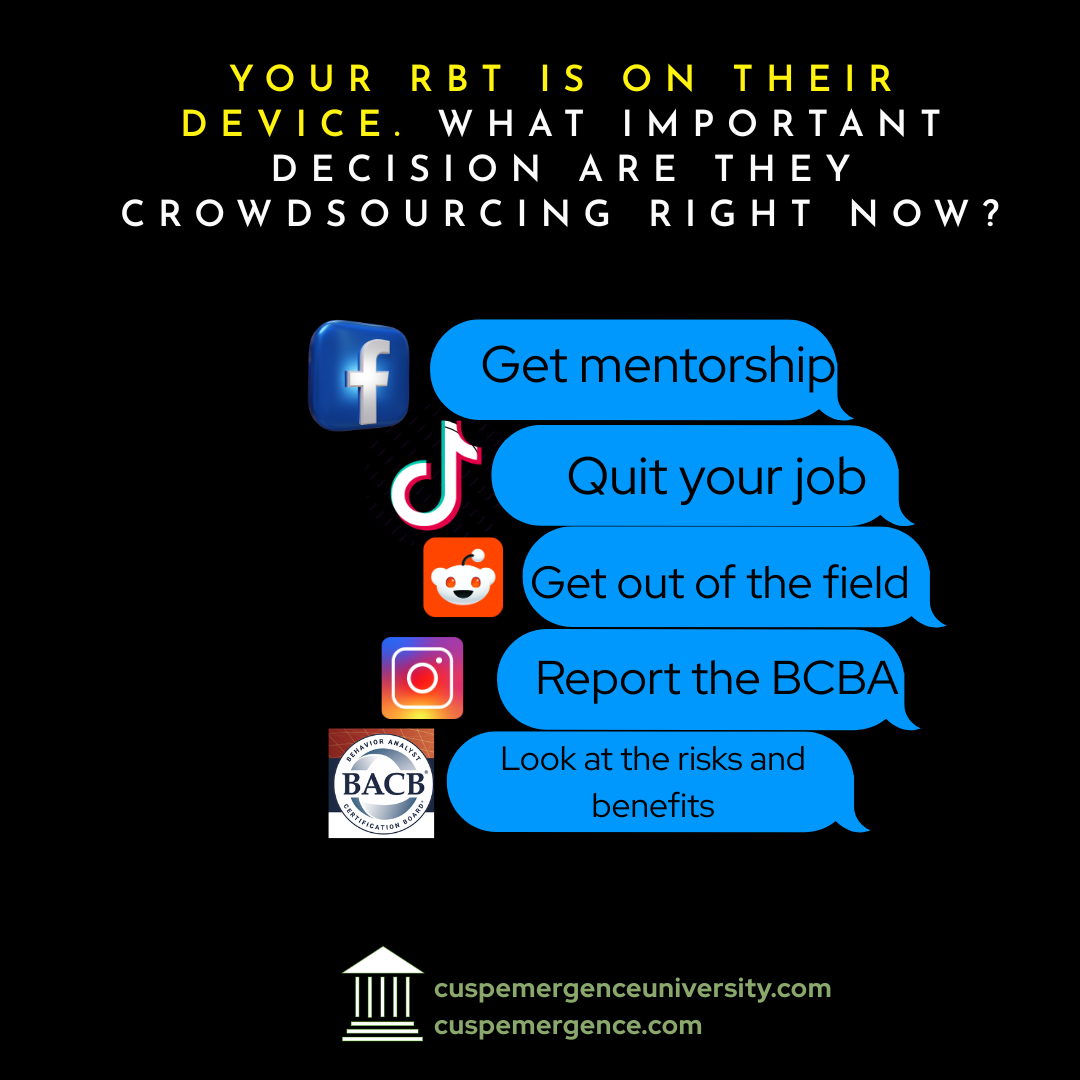
However, how many times do we vet each suggestion received, evaluate their source as credible or not, and see if there is a precedent in the literature if appropriate? How much of the time do those suggestions take into account the individualized needs of our client… while protecting their privacy and avoid sharing identifying info on social media? And how often do we actually receive advice that goes against ethics, best practice, or the law?

How is this type of course different?

  • Provides differentiated instruction: In this innovative hour with Dr. Camille Kolu, a BCBA supervisor and their RBT supervisee hear about the same topic. But level-individualized handouts provide the exercises, tools, and questions to help the RBT learn and apply new information, while the BCBA learns from a supervision perspective how to help someone else to learn skills and apply the ethics code in practical ways.
  • Uses modeling: Addressing the dyad together allows us to model supervision skills and tools for the BCBA, while the RBT gains new skills that will benefit them and their clients and team.
  • Quickly (in 1 hour) adds value to your team’s repertoire: The skills we teach in this series are all skills that are valuable for the clinician, client, and the team, and we select only skills that are most requested in our in-person trainings. The first course in the series teaches Risk Versus Benefit Analysis.

Unlike asking the internet what you should do in a tough ethical situation, conducting an individualized risk versus benefit analysis has many benefits.

The first and most obvious benefit is its outcome: doing the RVB results in several potentially satisfactory alternative options. And I love the fact that it can bring teams together, puts stimulus control over tough conversations, honors and documents voices that were not considered before, and leads to the kind of practical documentation we are asked to keep in the ethics code. (And, yes, we share a tool for that!)

So, what does this course do?

Through this 1 hour we spend together, RBTs learn many of the skills needed to encounter a behavioral cusp: completing their very own risk versus benefit assessments when faced with difficult situations.  

  • What do RBTs do in these courses? RBTs watch short videos, take quizzes, learn about ethics connections to their code, read their quiz feedback, answer thought questions, download and try out tools, and do exercises.
  • What does the supervising BCBA do? BCBAs do all of the above, but they also receive article suggestions and thought questions; notes and exercises on ethics connections, templates adapted to BCBA Ethics Code requirements, and readings and discussion questions just for them.

So where can I take this course!?

You can click on the link that’s best for you.  

  • RBTs, take this one:

https://www.cuspemergenceuniversity.com/courses/RBT-version-rvb-for-rbts

  • BCBA, take the Supervisor Version:

https://www.cuspemergenceuniversity.com/courses/Supervisor-Version-RVBs-for-RBTs

Can I gift one to my supervisor or RBT? Sure. You can always buy it as a gift for someone else in the checkout.

Can I get a group rate? Absolutely! Just select group and buy as many as you need at checkout. The group discounts will automatically apply.

Haven’t signed up for our Cusp Emergence University newsletter yet, where you’ll hear about new courses? Click here.

Have another question? I would be happy to hear from you! -Camille

← Back

Thank you for your response. ✨

Self-paced SAFE-T Assessment Training is here!

16 Tuesday Feb 2021

Posted by kolubcbad in adults, Autism, BACB CEU, Behavior Analysis, behavior cusp, Behavioral Cusp, CEU, children, collaboration, Community, continuing education, contraindicated procedures, Cusp Emergence University, CuspEmergenceUniversity, Education, ethics, mental health, resources, risk analysis, risk assessment, risk versus benefit analysis, supervision, teaching ethics, TI-ABA, TIABA, TIBA, trauma, trauma-informed behavior analysis, Uncategorized

≈ Leave a comment

Tags

behavior analysis, behavior analysis CEU, CEU, continuing education, cuspemergence, CuspEmergenceUniversity, ethics ceu, SAFE-T, SAFE-T Assessment, SAFE-T model, SAFET Model, supervision CEU, TI-ABA, TIABA, TIBA, trauma, trauma CEU, trauma-informed behavior analysis

It’s finally here! We have learned so much from workshop attendees, trainees and supervisees in this area over the past several years, and appreciate the attendance, feedback and support of everyone who has taken the training or used a version of the SAFE-T Assessment. Coming on Monday, the booklet and training for assessing trauma-related factors affecting our clients of behavioral services, are available ONLINE as a self-paced course. This course provides a download of the new and expanded SAFE-T Checklist booklet, which contains several tools enabling the screening and documentation of over 200 trauma-related factors, and a Risks and Needs form to help teams understand (and document) how these factors confer risks (and converge in risk factors that must be solved or mitigated to protect our clients, teams, and ourselves). The booklet contains an extensive reference section and team supportive tools as you use your new knowledge to better align your team’s skillset with the Ethics Code, and the individualized needs of behavior services clients after trauma.

Several of our behavior analytic and collaborator clients across institutions, educational facilities and private companies clients have shared that learning to assess risk factors related to trauma, and to apply this information to their teams’ FBAs and risk mitigation plans, took their skillset to the next level – essentially affording them an opportunity to acquire an important behavioral cusp for their teams.

Some new components of the booklet include:

  • An optional buffer/ resilience score to assess whether protective environmental and therapeutic components of a client’s plan are in place (to understand some ways that trauma gives rise to medical and behavioral challenges and some buffering factors that can help, please see the book or scholarly articles by Dr. Nadine Burke Harris (e.g., Oh D.L. et al. 2018), who is the Presidential Scholar for 2021’s upcoming Association for Behavior Analysis International’s conference. She will address the critical topic of breaking the intergenerational cycle of adversity, and screening for ACES (adverse childhood experiences).
  • Table of potentially contraindicated procedures (cross referenced with items and risk clusters assessed in the Risks and Needs form)
  • Information about over 50 risk clusters (groups of related risks in the 6 assessed sections of the SAFE-T Assessment)
  • Cross-reference tables showing, for each item we screen for, the location(s) in the SAFE-T Checklist
  • Infographic on components of a trauma-informed FBA
  • Brief templates for Risk Versus Benefit Analysis and Risk Mitigation Planning
  • The IPASS (Inventory of Potential Aversive Stimuli and Setting Events) tool and instructions
  • References (organized by topics) covering over 40 areas or topics of literature related to trauma (including relationships of ACES to medical problems, ACT and intellectual disability, ACT and anxiety, foster care and adoption, the relationship of abuse to pain, drug use and trauma, and much more).

Time required: The course includes about 4.5 hours of video content in 12 lessons, each followed by a brief quiz.

Price (includes 4.5 CEU course and SAFE-T Assessment booklet download): $189.99

For $20 off through the end of February, use the coupon code “SAFET20”.

To register: cusp.university

Upcoming: Brief webinar series on TIBA in partnership with Connections-Behavior.com

28 Thursday May 2020

Posted by kolubcbad in adults, Autism, BACB CEU, Behavior Analysis, CEU, Community, continuing education, Education, Education and Trauma-Informed Behavior Analysis, supervision, teaching behavior analysis, teaching ethics, TIBA, trauma, trauma-informed behavior analysis, Uncategorized

≈ Leave a comment

Tags

CEU, ceu bacb, TIBA, trauma, trauma-informed behavior analysis

Now that the annual conference for ABAInternational is past (whew!), Cusp Emergence is excited about upcoming webinars and online conferences (New Hampshire and FABA, I’m looking at you!). First up is a partnership with Connections-Behavior.com: We will look at trauma-informed behavior analysis in two parts, on June 1 and 15. Register here for this CEU opportunity!

CEU stands for Cusp Emergence University!

13 Tuesday Nov 2018

Posted by kolubcbad in About, BACB CEU, Behavior Analysis, boundaries of competence, CEU, continuing education, Education, ethics, learning, resources, risk analysis, risk assessment, teaching behavior analysis, teaching ethics, trauma, trauma-informed behavior analysis, Uncategorized

≈ Leave a comment

Tags

BACB CEU, CEU, continuing education, ethics, trauma, trauma-informed behavior analysis

Need training for your team in trauma-informed behavior analysis? Cusp Emergence University has launched! 

Come check out the site, sign up for one of Dr. Kolu’s courses, or just have a look around.

While we’re beta testing, save 15% on 3 CEU’s in a 2.5 hour continuing education course (Introduction to the Ethics of Trauma-Informed Behavior Analysis).

This course is for intermediate audiences interested in learning more about the ethics of trauma-informed behavior analysis, or using behavior analysis to provide responsible, evidence-based and sensitive support to individuals whose backgrounds include early or serious adverse experiences. Take this course to prepare your practice and team and plan for the increased risks associated with this population. BACB certificants receive your certificate upon completion of the course, which includes quiz questions to help keep you engaged. Course includes 2 ethics CEU’s.

DISCLAIMER: Dr. Camille Kolu of Cusp Emergence is a Behavior Analysis Certification Board (BACB) approved ACE provider. Advertisements for new continuing education opportunities (per the board requirements) will often be placed here. Check cuspemergenceuniversity.com for the full details, to enroll in courses, or to learn more about the continuing education opportunities provided.  The BACB does not endorse any individual courses.

Come back to the tab Cusp Emergence University, or check out CuspEmergenceUniversity.com  any time for updates on courses in development.

Recent Posts

  • NEW: Professional Development for RBTs!
  • Lessons from a Lost Balloon: Growth, Safety, and Kindness
  • Behavioral Seismology
  • 10 Actions This Year: A call-in if you read Boggs et al. (2025)
  • Understanding Values: The Connection to Context and Action

Archives

  • July 2026
  • July 2025
  • May 2025
  • November 2024
  • February 2024
  • June 2023
  • April 2023
  • March 2023
  • October 2022
  • February 2022
  • October 2021
  • August 2021
  • February 2021
  • September 2020
  • May 2020
  • March 2020
  • November 2019
  • September 2019
  • June 2019
  • January 2019
  • November 2018
  • October 2018
  • September 2018
  • July 2018
  • May 2018
  • April 2018
  • March 2018
  • February 2018
  • October 2017
  • September 2017
  • August 2017
  • July 2017
  • May 2016
  • September 2014
  • July 2013
  • June 2013
  • May 2013
  • April 2013
  • March 2013
  • February 2013
  • January 2013
  • December 2012
  • November 2012
  • October 2012
  • August 2012

Categories

  • About
  • acquisition
  • adults
  • Autism
  • BABA
  • BACB CEU
  • Behavior Analysis
  • behavior cusp
  • Behavioral Cusp
  • boundaries of competence
  • buffers and barriers
  • CASA
  • CEU
  • children
  • collaboration
  • Community
  • conferences
  • contextual fear conditioning
  • continuing education
  • contraindicated procedures
  • coronavirus
  • Court Appointed Special Advocate
  • Covid-19
  • Cusp Emergence University
  • CuspEmergenceUniversity
  • data
  • dementia
  • Early Intervention
  • edtiba
  • EDTIBA10
  • Education
  • Education and Trauma-Informed Behavior Analysis
  • elopement
  • Emergence
  • enriched environment
  • ethics
  • extinction
  • FAS
  • FASD
  • Fetal Alcohol Spectrum Disorders
  • flood
  • functional alternative behavior
  • hospital
  • hurricane
  • job aids
  • learning
  • mental health
  • Neuroscience
  • play
  • podcast
  • praise
  • RAD
  • reactive attachment disorder
  • renewal effect
  • resources
  • Rett's
  • risk analysis
  • risk assessment
  • risk versus benefit analysis
  • safety skills
  • sale
  • schedules of punishment
  • self injurious behavior
  • Social Interaction
  • stimulus schedules
  • supervision
  • teaching behavior analysis
  • teaching ethics
  • TI-ABA
  • TIABA
  • TIBA
  • trauma
  • trauma-informed behavior analysis
  • Uncategorized
  • variability

Meta

  • Create account
  • Log in
  • Entries feed
  • Comments feed
  • WordPress.com

Blog at WordPress.com.

  • Subscribe Subscribed
    • Cusp Emergence
    • Join 123 other subscribers
    • Already have a WordPress.com account? Log in now.
    • Cusp Emergence
    • Subscribe Subscribed
    • Sign up
    • Log in
    • Report this content
    • View site in Reader
    • Manage subscriptions
    • Collapse this bar
Loading Comments...