
Tags
bacb, BCBA, CEU, cusp emergence, Cusp Emergence University, cuspemergence-com, cuspemergenceuniversity-com, decision-making, dyad, education, ethics, kolu, PDU, professional development, professional development for dyads, RBT, risk versus benefit, risk versus benefit analysis, super5vision-ceu, supervision, supervision CEU, teresa kolu, teresa-camille-kolu, writing
(Spoiler alert: BCBAs get supervision credit too!)
A few years ago, Cusp Emergence began to notice something. The folks at my trainings were often RBTs! Registered Behavior Technicians (RBTs) are certified by the Behavior Analysis Certification Board (BACB); they work on the front lines doing some of the hardest, lowest-paid jobs in our field, and they get the brunt of the most difficult behavior. (And you know I don’t refer only to behavior emitted by clients; we all realize that staff and caregiver interactions can contribute to the most challenging parts of our work weeks).
You’d think all this makes an RBT the most respected, cared-for person in the organization. Surely they are valued like nurses, revered like clergy, paid like winning quarterbacks, and trained like the champs they are going to have to be for those marathon sessions in clients’ homes, the community, and the clinic where they are providing the majority of hours you submit to insurance for compensation.
But that’s not the case. In fact, we’re guilty of it too: Cusp Emergence University has never recorded a “for-RBTs-training”….
That’s all changing with our new series, Professional Development for Dyads.
What’s a dyad?
A dyad is two people. Maybe the two people are related through their roles, jobs, family (like when we address a caregiver and their baby in early intervention, or a couple in a relationship). In this case, we want to address the RBT and their supervising BCBA (although each of them is welcome to take the course on their own).
Why teach RBTs to conduct Risk Versus Benefit Analysis?
Social media tempts and reinforces our behavior of crowdsourcing (and even outsourcing) our decision-making in difficult situations. In fielding or asking questions on facebook, tiktok, Instagram, or reddit, you’ve seen the following situation:
An RBT or BCBA brings up a tough situation and tries to crowd-source the answer to “what do I do?”. These are not always unique situations; many of them are familiar or someone has faced them before. And it is helpful to gain perspective if someone else has.
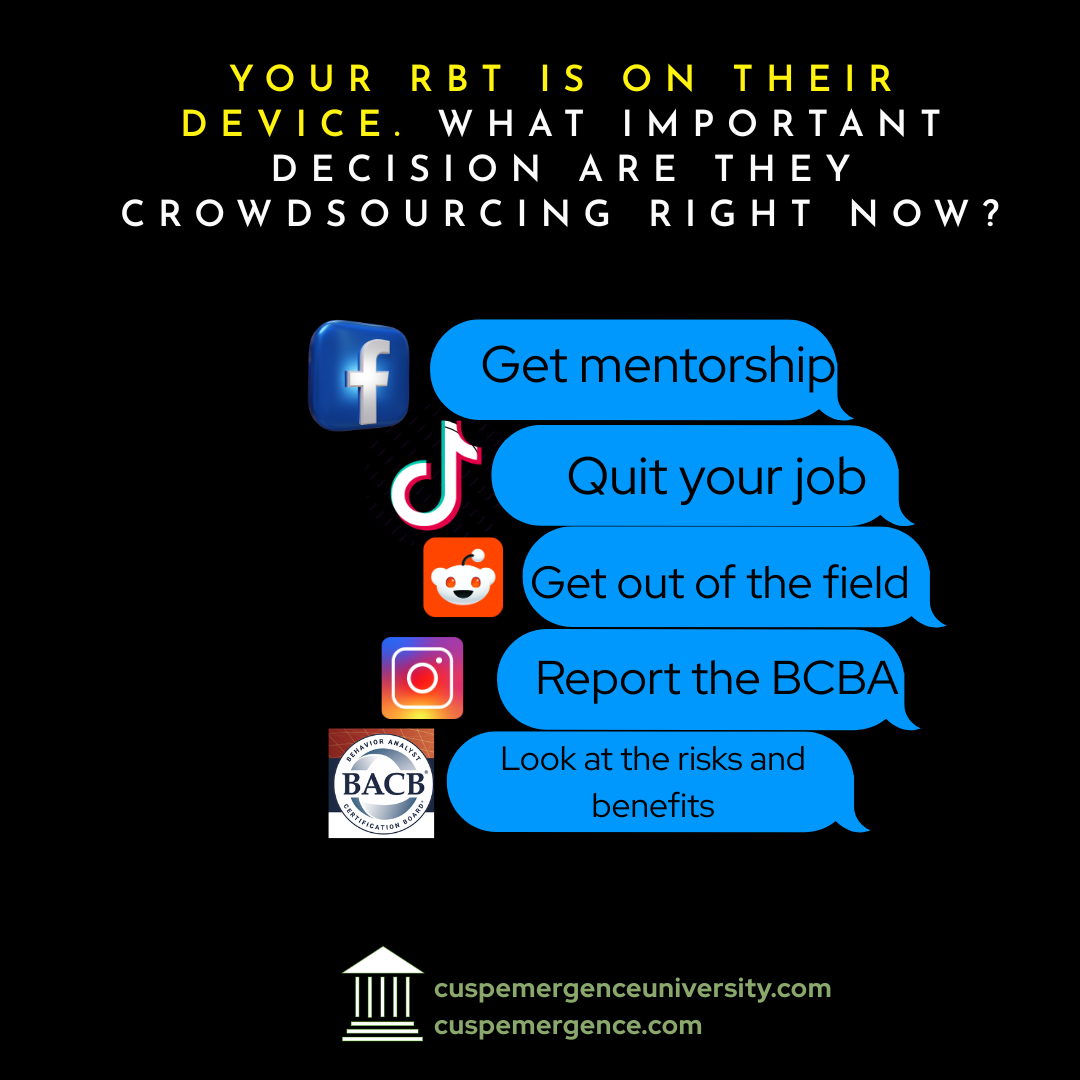
However, how many times do we vet each suggestion received, evaluate their source as credible or not, and see if there is a precedent in the literature if appropriate? How much of the time do those suggestions take into account the individualized needs of our client… while protecting their privacy and avoid sharing identifying info on social media? And how often do we actually receive advice that goes against ethics, best practice, or the law?
How is this type of course different?
- Provides differentiated instruction: In this innovative hour with Dr. Camille Kolu, a BCBA supervisor and their RBT supervisee hear about the same topic. But level-individualized handouts provide the exercises, tools, and questions to help the RBT learn and apply new information, while the BCBA learns from a supervision perspective how to help someone else to learn skills and apply the ethics code in practical ways.
- Uses modeling: Addressing the dyad together allows us to model supervision skills and tools for the BCBA, while the RBT gains new skills that will benefit them and their clients and team.
- Quickly (in 1 hour) adds value to your team’s repertoire: The skills we teach in this series are all skills that are valuable for the clinician, client, and the team, and we select only skills that are most requested in our in-person trainings. The first course in the series teaches Risk Versus Benefit Analysis.
Unlike asking the internet what you should do in a tough ethical situation, conducting an individualized risk versus benefit analysis has many benefits.
The first and most obvious benefit is its outcome: doing the RVB results in several potentially satisfactory alternative options. And I love the fact that it can bring teams together, puts stimulus control over tough conversations, honors and documents voices that were not considered before, and leads to the kind of practical documentation we are asked to keep in the ethics code. (And, yes, we share a tool for that!)
So, what does this course do?
Through this 1 hour we spend together, RBTs learn many of the skills needed to encounter a behavioral cusp: completing their very own risk versus benefit assessments when faced with difficult situations.
- What do RBTs do in these courses? RBTs watch short videos, take quizzes, learn about ethics connections to their code, read their quiz feedback, answer thought questions, download and try out tools, and do exercises.
- What does the supervising BCBA do? BCBAs do all of the above, but they also receive article suggestions and thought questions; notes and exercises on ethics connections, templates adapted to BCBA Ethics Code requirements, and readings and discussion questions just for them.
So where can I take this course!?
You can click on the link that’s best for you.
- RBTs, take this one:
https://www.cuspemergenceuniversity.com/courses/RBT-version-rvb-for-rbts
- BCBA, take the Supervisor Version:
https://www.cuspemergenceuniversity.com/courses/Supervisor-Version-RVBs-for-RBTs

Can I gift one to my supervisor or RBT? Sure. You can always buy it as a gift for someone else in the checkout.
Can I get a group rate? Absolutely! Just select group and buy as many as you need at checkout. The group discounts will automatically apply.
Haven’t signed up for our Cusp Emergence University newsletter yet, where you’ll hear about new courses? Click here.
Have another question? I would be happy to hear from you! -Camille


