
• TIBA (Trauma-Informed BA) articles
  • Cusp Emergence in the Community
  • About Cusp Emergence
  • About Dr. Kolu
  • ETHICS
  • Cusp Emergence University
  • Resources
  • Mentorship
  • Buffers
  • Behavioral Seismology: Predicting Behavioral Needs During Hormonal Changes

Cusp Emergence

~ Collaborating ~ Consulting ~ Constructing Repertoires

Cusp Emergence

Tag Archives: CuspEmergenceUniversity

What are some relationships between buffers and triggers?

Featured

Posted by kolubcbad in adults, Autism, BACB CEU, CEU, children, Community, continuing education, Cusp Emergence University, CuspEmergenceUniversity, enriched environment, TI-ABA, TIABA, TIBA, trauma, trauma-informed behavior analysis, Uncategorized

≈ Leave a comment

Tags

autism, barriers, buffers, buffersandbarriers, children, cuspemergence, CuspEmergenceUniversity, family, kids, motherhood, parenting, parents, TIBA, trauma-informed behavior analysis, triggers

Another article in the TIBA series by Dr. Teresa Camille Kolu BCBA-D

In Chapter 8 of our course on Trauma Sensitivity, we cover the concept of “triggers” and what we can do about them. We cover this mostly from a responsive perspective in the course and use the following operational definition: “Triggers are historically meaningful stimulus complexes or relations between them. In their presence, behaviors or response patterns may be temporarily more likely to occur.” We continue with the big idea from Chapter 8 of that course, “One of the most supportive actions we can take is to stay mindful and do what needs doing in the moment”.

However, another huge thing we can do in helping someone through those triggering events or moments is to plan ahead. Below are some questions we ask our clients and their family members to answer, if they are interested in exploring this. Read on if you’re interested in some examples (we share a brief example of a dyad’s answers, where one member is the 5 year old kid, and the other is a parent). (Oh, and it may be helpful to check out the IPASS (find it in our RESOURCES tab)- this is a little tool we use for folks to go through their sensory environment for clues about triggers, if they need somewhere to start.)

Questions:

1.Name a person you love or a primary relationship you care deeply about.

2.Name an action that you do that shows compassion with them.

3.Name some things the person also does… that REALLY get under your skin.

4.Name an environmental situation or trigger that happens right before it is HARDEST to keep your cool.

5.List some things you start to notice when you’re feeling about to blow up/ lose your cool/ start doing actions that are inconsistent with your values to that #1 person.

6.State things you do to calm down in those moments that REALLY work or are most likely to work.

7.If you DIDN’T act to calm down and things kept getting worse, state the action(s) you would be likely to use next in the presence of that person.

Growth statement: Write your plan to prevent the triggers (3 and 4 above) from leading to actions that are inconsistent with your values (e.g., 7), by doing (6) as soon as you begin to notice things about your insides or the outside environment (5).

Ready to see this in action? Below are some parent answers. Keep in mind that neurodivergent parents often have neurodivergent children (or, looking backward, that neurodivergent children often have neurodivergent parents, whose qualities might not be appreciated until later, in the context of exploring diagnoses with their own children). Have you ever seen a mom struggling with her own misophonia exactly at the same time her child uses loud repetitive noises? Talk about triggering (for and to each other)! But stay hopeful and in the moment, because as hard as it is to be the thing in your loved one’s environment that sets them off, it’s lovely to be the person in their environment who can really understand where they’re coming from.

Parent Example: Answers to 7 questions, above

1.I love my kids.

2.I love it when I am able to use kind words and a calm voice with them.

3.Sometimes my kid makes repetitive noises, does not listen or interrupts me, or doesn’t follow instructions.

4.It is most difficult to keep my cool with my kids when I’m running late somewhere and my kid is not following instructions or is not doing something the “right” way.

5.I start to notice my face getting hot, my neck and face muscles are strained, and my breathing is shallow and fast. 

6.If I splash water on my face, relax my muscles, stop and hug my kid, and breathe deeply, it helps to calm me down in the moment.

7.If I skip that step above, I usually proceed to raise my voice and may even shout or say things I don’t mean (things that are not kind and compassionate).

Parent Growth plan: “When I’m late somewhere and it’s really noisy, it’s especially important that I start to notice when I’m using shallow breath, the noise around me is increasing, or I’m noticing everything “wrong” my kids do and nothing right they’re doing. Right then, before I talk to my kid, I need to immediately try some of my calming strategies I listed above.”

OK, now for the kid’s answers.

1.I love my mom and baby brother.

2.I love it when I am able to keep playing, share, have fun.

3.Sometimes my mom tells me to stop doing something I love or tells me how to do something better or my brother takes my stuff.

4.When mom yells or my brother takes my stuff or we have to leave my game or book, it is most difficult to keep my cool.

5.I start to notice my face getting hot, my movements are jerky, my chest hurts, and my breathing is fast. 

6.If I hug my mom, splash water on my face, stop and do some jumping jacks and then sit and breathe, it helps to calm me down in the moment.

7.If I skip that step above, I usually yell, hit my brother, or shout “NO! I WON’T!”.

Growth plan my parents can help with: When I’m being asked to stop playing or to do something that interrupts my flow, notice when I’m breathing faster and having a hard time talking. You can help by giving me a hug, doing some jumping jacks with me, and sitting with me and helping me to breathe.

At this point, we ask the parent some meaningful questions to help them make sense of what we’re noticing. And often this is uncomfortable (but becomes exciting and doable) as they first think, “oh, but won’t we be reinforcing escalation?” No, we’re turning it off.

Parents or caregivers, did you notice…

-Whether your having a hard time makes it harder for you to help your other person with THEIR hard time?

-Whether your hard time perhaps CONTRIBUTES to their hard time?

-Whether your triggers are echoed by the ones that seem to affect your kid or client? (e.g., are you teaching your other person to struggle with the same thing you struggle with, without your meaning for this to happen)?

-Whether your triggers might be easier to manage at a period of time when you (or both of you) are well fed, rested, and exercised?
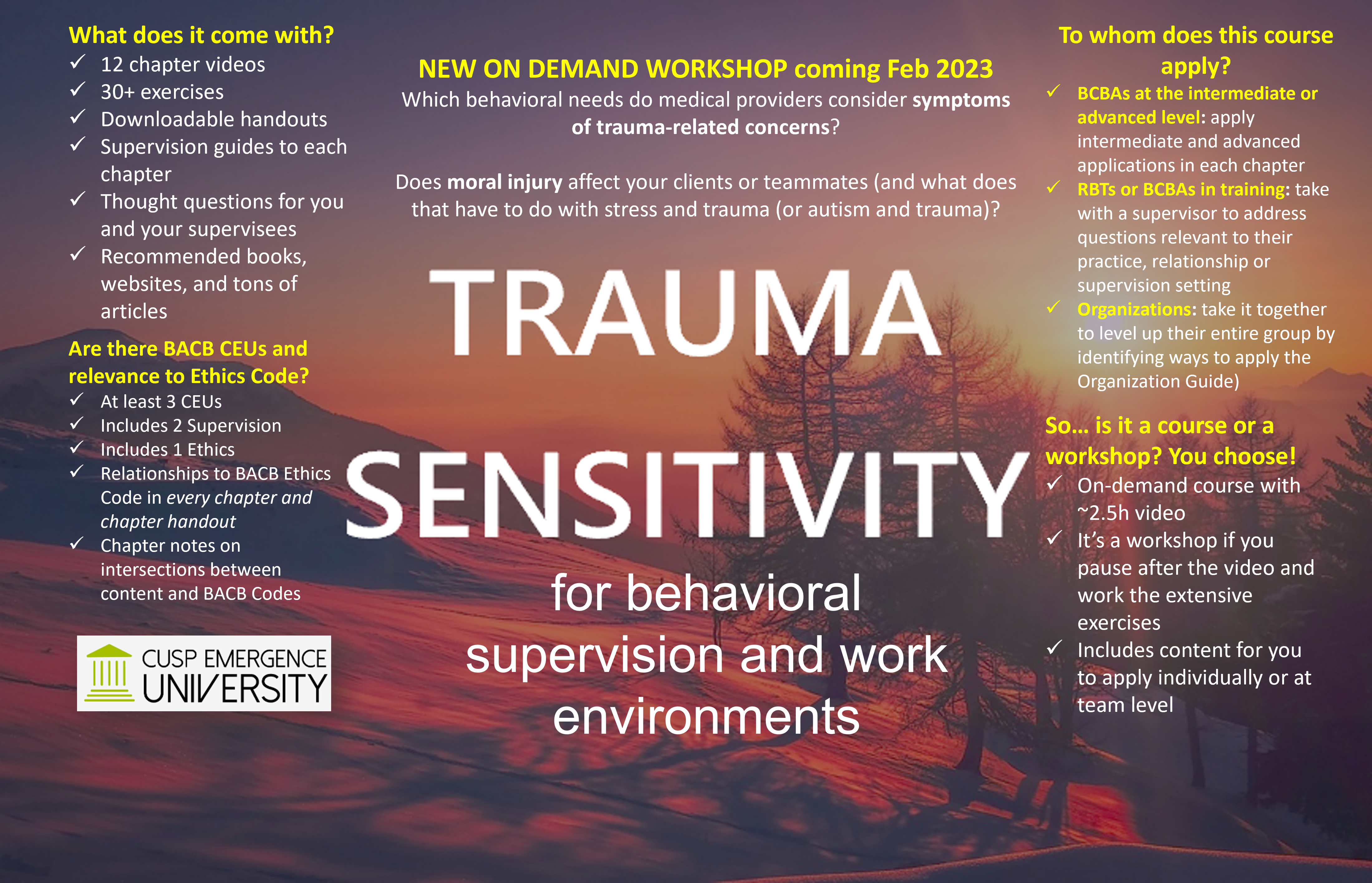
Have you ever taken an on-demand workshop?

02 Thursday Mar 2023

Posted by kolubcbad in adults, Autism, BACB CEU, Behavior Analysis, Behavioral Cusp, boundaries of competence, CEU, children, collaboration, Community, continuing education, Cusp Emergence University, CuspEmergenceUniversity, supervision, teaching behavior analysis, teaching ethics, TI-ABA, TIABA, TIBA, trauma, trauma-informed behavior analysis, Uncategorized

≈ Leave a comment

Tags

BACB CEU, bacb ethics ceu, bacb supervision ceu, bcba-d courses, camille kolu, camille parsons, CuspEmergenceUniversity, ethics ceu, kolu, new course, on-demand workshop, supervision CEU, teresa kolu, trauma sensitivity, trauma sensitivity workshop, trauma-informed behavior analysis

For me, an on-demand workshop does several things: It can be taken any time; one can take it with a group and apply exercises with other people if desired; but since it’s on-demand, an individual will benefit even if taking it solo. It should be expandable if one wants to be able to sit with a chapter for a few extra hours because we simply love the content; there will be resources to grow with and come back to if one can’t do all the exercises right NOW. I’ve been on sabbatical a while; as I return to doing interviews, conferences, talks, and podcasts (including a new one we taped recently for the Atypical Behavior Analyst, with my friend Dr. Eddie Fernandez airing later), it is nice to be able to take something on my own time, when tiny folks are asleep, and I know many parents – and folks going through school and work at the same time – are in the same boat.

So after taking an on-demand online workshop recently, we decided to present some of our own new content in an expandable workshop format instead of the typical course, including several features. Our new Trauma Sensitivity workshop includes:

  1. 30+ exercises with the videos: Because this is an on-demand workshop, we present a TON of exercises packaged with the videos. Teams or individuals can easily do a chapter a week along with exercises for a truly transformative experience in your office or supervision setting. But if they choose to take it all at once in an afternoon, that’s possible too. So it’s customizable.
  2. Scalable applications for team members, supervisors and supervisees: The new content (on leveling up the trauma sensitivity of our staff and client environments) is “scalable”, meaning we include applications for 3 different levels of staff: those in roles that are basic; intermediate; and advanced. Presenting it as a workshop meant that the team members “leading” the discussions and exercises benefit just as much as (but different from) the less advanced team members they are mentoring through it.
  3. Supervision guides and chapter handouts: These come with every chapter video and walk the student through the material, from the main ideas we presented, to definitions for any new vocabulary, exercises, lists of Ethics Code items that relate, thoughtful discussion questions, exercises, and chapter resources and articles. Every chapter comes with its own handout and supervision guide to help BACB supervisors or team leaders support our coworkers and supervisees.

The two things I personally love most about this workshop are:

  1. it addresses tough topics like moral injury with your team members and considering how this ethics area could apply to our supervisees but our clients too;
  2. and we provide resources to follow up on big ideas like this one: there are some behavioral needs that medical providers consider symptoms of trauma-related concerns. (If folks are new to integrating trauma sensitivity in their supervision and client environments, we might miss this huge opportunity to make sure we do no harm by treating behavior needs that are actually related to new abuse.)

Wondering about the content of the new workshop? Here are the chapters (each has its own video, ethics intersections, resources, thought questions, and exercises):

Chapter 1: Principles of Trauma-Sensitive Care  
Chapter 2: Interactions that could help or do harm
Chapter 3: Features of trauma-related responding  
Chapter 4: Defining trauma  
Chapter 5: Risks related to trauma  
Chapter 6: Elements of a potentially trauma-related response  
Chapter 7: Buffers
Chapter 8: Triggers (Then watch integration Scenario Video)
Chapter 9: Neurodevelopment
Chapter 10: Want to mitigate risk? Document it first
Chapter 11: Skills and Stress
Chapter 12: Healthy Collaboration  
Above: Table of chapters from Trauma Sensitivity in the Behavioral Workplace, new on-demand workshop from Cusp Emergence

Did you enjoy this article? Come back soon when we’ll cover a few more related topics including: mentorship groups for those applying trauma sensitivity principles in their supervision sessions; how to get the most out of your workshop experience by doing exercises as a group or dyad; more info on a brand new all-trauma conference coming in April hosted by the formidable Dr. Gabi Morgan; meetups in Denver May 2023; and more!

Read below for final thoughts and some links if you’re in the market for values related CEUs: Recently, when my own CEU cycle was about to turn over, I knew it was time to take a course or workshop in something I could use NOW and am passionate about… so I went searching for three things: supervision CEUs; offerings from people I admire and from folks who literally wrote the books on leveling up mentorship and supervision and working with families; and opportunities to learn about values in a deeper way that would help me level up my own practice. That led me to a couple of great courses and podcasts; one of these opportunities was a workshop with built in exercises that could be taken quickly or over the course of a few weeks and included opportunities to network with other folks. It was a really lovely experience. Included are links to a couple trainings and podcasts from respected folks who continue to inspire, below.

https://podcasts.apple.com/us/podcast/the-journey-of-supervision/id1501568747?i=1000485543749

https://evelyngouldphd.com/news/events/20220915-acting-on-a-value-of-self-care-on-demand/

https://www.weareconstellations.com/current-workshops

And here’s the trauma sensitivity on-demand workshop: https://www.cuspemergenceuniversity.com/courses/trauma-sensitivity

Self-paced SAFE-T Assessment Training is here!

16 Tuesday Feb 2021

Posted by kolubcbad in adults, Autism, BACB CEU, Behavior Analysis, behavior cusp, Behavioral Cusp, CEU, children, collaboration, Community, continuing education, contraindicated procedures, Cusp Emergence University, CuspEmergenceUniversity, Education, ethics, mental health, resources, risk analysis, risk assessment, risk versus benefit analysis, supervision, teaching ethics, TI-ABA, TIABA, TIBA, trauma, trauma-informed behavior analysis, Uncategorized

≈ Leave a comment

Tags

behavior analysis, behavior analysis CEU, CEU, continuing education, cuspemergence, CuspEmergenceUniversity, ethics ceu, SAFE-T, SAFE-T Assessment, SAFE-T model, SAFET Model, supervision CEU, TI-ABA, TIABA, TIBA, trauma, trauma CEU, trauma-informed behavior analysis

It’s finally here! We have learned so much from workshop attendees, trainees and supervisees in this area over the past several years, and appreciate the attendance, feedback and support of everyone who has taken the training or used a version of the SAFE-T Assessment. Coming on Monday, the booklet and training for assessing trauma-related factors affecting our clients of behavioral services, are available ONLINE as a self-paced course. This course provides a download of the new and expanded SAFE-T Checklist booklet, which contains several tools enabling the screening and documentation of over 200 trauma-related factors, and a Risks and Needs form to help teams understand (and document) how these factors confer risks (and converge in risk factors that must be solved or mitigated to protect our clients, teams, and ourselves). The booklet contains an extensive reference section and team supportive tools as you use your new knowledge to better align your team’s skillset with the Ethics Code, and the individualized needs of behavior services clients after trauma.

Several of our behavior analytic and collaborator clients across institutions, educational facilities and private companies clients have shared that learning to assess risk factors related to trauma, and to apply this information to their teams’ FBAs and risk mitigation plans, took their skillset to the next level – essentially affording them an opportunity to acquire an important behavioral cusp for their teams.

Some new components of the booklet include:

  • An optional buffer/ resilience score to assess whether protective environmental and therapeutic components of a client’s plan are in place (to understand some ways that trauma gives rise to medical and behavioral challenges and some buffering factors that can help, please see the book or scholarly articles by Dr. Nadine Burke Harris (e.g., Oh D.L. et al. 2018), who is the Presidential Scholar for 2021’s upcoming Association for Behavior Analysis International’s conference. She will address the critical topic of breaking the intergenerational cycle of adversity, and screening for ACES (adverse childhood experiences).
  • Table of potentially contraindicated procedures (cross referenced with items and risk clusters assessed in the Risks and Needs form)
  • Information about over 50 risk clusters (groups of related risks in the 6 assessed sections of the SAFE-T Assessment)
  • Cross-reference tables showing, for each item we screen for, the location(s) in the SAFE-T Checklist
  • Infographic on components of a trauma-informed FBA
  • Brief templates for Risk Versus Benefit Analysis and Risk Mitigation Planning
  • The IPASS (Inventory of Potential Aversive Stimuli and Setting Events) tool and instructions
  • References (organized by topics) covering over 40 areas or topics of literature related to trauma (including relationships of ACES to medical problems, ACT and intellectual disability, ACT and anxiety, foster care and adoption, the relationship of abuse to pain, drug use and trauma, and much more).

Time required: The course includes about 4.5 hours of video content in 12 lessons, each followed by a brief quiz.

Price (includes 4.5 CEU course and SAFE-T Assessment booklet download): $189.99

For $20 off through the end of February, use the coupon code “SAFET20”.

To register: cusp.university

Seeing Snakes and Spiders

27 Friday Sep 2019

Posted by kolubcbad in BACB CEU, Behavior Analysis, boundaries of competence, CEU, children, collaboration, Community, continuing education, Cusp Emergence University, CuspEmergenceUniversity, edtiba, EDTIBA10, Education, Education and Trauma-Informed Behavior Analysis, ethics, mental health, resources, sale, teaching behavior analysis, teaching ethics, TIBA, trauma, trauma-informed behavior analysis, Uncategorized

≈ Leave a comment

Tags

ABA, continuing education, CuspEmergenceUniversity, edtiba, ethics, events, mental health, resources, trauma-informed behavior analysis

This is the 17th article in a series on Trauma-Informed Behavior Analysis by Dr. Teresa Camille Kolu, Ph.D., BCBA-D.

spider

What did you do when you saw this picture? Chances are you experienced some additional events beyond just “seeing it”. Did you jump? Experience an increase in your breathing rate? Use some choice verbal behavior? Avert your eyes? (And are you prepared to read on? Fair warning… there’s a snake coming up).

Seeing with fresh eyes

I noticed a couple of things about our culture, and fear responses, this past week.

My young daughter’s love for flap books—the kind where you pull back a piece of paper to reveal something—knows no bounds. So she was instantly drawn to a tattered old library copy (apparently she shares this love with lots of peers) of “Buzz Buzz, Baby”- with poorly rendered babies exploring “bugs”. Around the third page the baby pulls back a web flap to unveil, in the book’s words, “EEK! The itsy bitsy spider!”

Whenever I read the book to her I leave out the “Eek!”.

I think she can come up with that on her own, if she happens to, although chances are she’ll get it from me in a non-mindful moment. (In the 1980’s Cook and Mineka did a classic study in which infant monkeys “acquired” a persistent fear of snakes by watching their scared mothers encounter a snake).

Now that we’ve moved out to the country, we encounter our own “Itsy” (and many for whom that name is woefully inadequate) all the time. (I do recommend this thing called the BugZooka… it does work really well, if you like catch-and-release). Itsy and I go way back, and not necessarily in a good way, although I always appreciate her beauty. But I still want to be warned before you text me her picture, dad.

This summer, one tenacious spider (pictured, top) built a web, over and over, in a windy area outside the kitchen, where we see it numerous times daily. The first few (ok, few hundred) times I nearly jumped out of my skin. When I remembered in time, I was very careful to breathe and compose myself before walking to the sink with my daughter, where I’d point out the spider cheerfully and sing (with all the hand movements) the requisite song. Before long she was signing the song herself. Next I noticed myself no longer jumping when I saw the spider.

THEN… one windy morning Itsy was gone. Gone!

I didn’t breathe a sigh of relief.

I was surprised and curious to feel a strange emotion… like MISSING. I missed her! Was she alright? Would she come back? (She was. She did).

With painful awareness that this is temporary, I often marvel that my daughter’s eyes are not only young… they are unconditioned. They don’t have a lot of pairings with events like scary movies about this deep primate fear, being bitten, or seeing spiders while a parent jumps and screams. They are fresh, curious, hopeful eyes.

Yesterday we chanced upon something rather larger than even the biggest spider. It was this old girl… fat and long, with ring upon ring adorning her useful brown rattle. Depending on my readers, maybe you’ll be happy that instead of grabbing a hoe, I called a guy I read about in my new community’s online forum… apparently this guy LOVES snakes. “ANY snake’s worth my time”, he told me as he jumped in his truck. 35 minutes later he had driven up to our homestead, hooked it and taken it. Now it’s in a quite different rattlesnake heaven than the kind I had sort of planned to send it… blissing out in a protected wilderness area up near Fort Collins, I’m told.

rattler

As he removed our snake into a large vented box and curiously counted the rings (while remarking on how huge it was), the guy’s face was composed; he exuded a strange calm excitement. Normally, the fear response to snakes and spiders is part of our biology. Evolutionary biology has several theories why it’s present even in infancy, and why it might have behooved our ancestral mothers to experience more arousal and get out of there to protect their young in the presence of these critters. I can’t help but wonder what this guy’s history is like. Why does he love something that most of us are scared of?

Kids with traumatic histories

If you’re an educator going back to school, many of your kids are coming in with an avoidance response, or a “get out of there!” escape response, ready to go. Some of them will use these responses in the most annoying ways, dropping all their work on the floor or crawling under desks when you announce the quiz. But some of them have a special background you can’t see. For some, they will use these “fear responses” when they encounter “triggers” that you and I do not think of as scary.

Why is that?

Well, the things that were there when they experienced really bad situations are now “paired”, living together in their past, the same way I smelled an old lady yesterday wearing my own granny’s soap and got emotional thinking about my dear departed loved ones. Or the same way you hear a certain song from your high school dance and think about that year, or that person, or that kiss.

And that’s not all. Psychology explains in anxiety journals why, if you’re a person with an intense “fear” or phobia of spiders, not only do you spot them more quickly and tend to see them where your peers might see other things, like mushrooms or flowers faster in the SAME PICTURE—but to you, they also appear BIGGER.

What can we do about it?

How can we help students show up for their education and get all the learning opportunities they can… even when the school, teachers, and peers accidentally give them “fear related” stimuli all day long? (While psychology explains partly WHY these pairings happen, behavior analysis does too, especially if you read some relational frame theory, learn about respondent conditioning, and take a long-term functional analytic approach. Behavior analysis also goes a long way in helping the helpers undo some of the damage, teaching kids to approach adults and “unpair” adult attention from it’s previously bad parts: if I’m a student who has been through neglect abuse, my teacher coming over to me to praise my “good behavior” might not be a welcome stimulus at first… and my teacher’s praise, as well-intentioned as it may be, might not work).

Cusp Emergence University has been hard at work getting the new online training course ready for educators, and behavior analysts who work in education. We hope to help you to start answering these questions for yourself and your students and teams. On Monday, September 30, our course “Education and Trauma-Informed Behavior Analysis” opens to a 7 day sale (use the code EDTIBA10 for 10 percent off this CEU opportunity). We’re providing BCBA’s and BCBA-D’s with 3.5 continuing education credits, and 3 of those are in ethics.

coupon

Sign up now!

Recent Posts

  • Lessons from a Lost Balloon: Growth, Safety, and Kindness
  • Behavioral Seismology
  • 10 Actions This Year: A call-in if you read Boggs et al. (2025)
  • Understanding Values: The Connection to Context and Action
  • I love you more than biscuits

Archives

  • July 2025
  • May 2025
  • November 2024
  • February 2024
  • June 2023
  • April 2023
  • March 2023
  • October 2022
  • February 2022
  • October 2021
  • August 2021
  • February 2021
  • September 2020
  • May 2020
  • March 2020
  • November 2019
  • September 2019
  • June 2019
  • January 2019
  • November 2018
  • October 2018
  • September 2018
  • July 2018
  • May 2018
  • April 2018
  • March 2018
  • February 2018
  • October 2017
  • September 2017
  • August 2017
  • July 2017
  • May 2016
  • September 2014
  • July 2013
  • June 2013
  • May 2013
  • April 2013
  • March 2013
  • February 2013
  • January 2013
  • December 2012
  • November 2012
  • October 2012
  • August 2012

Categories

  • About
  • acquisition
  • adults
  • Autism
  • BABA
  • BACB CEU
  • Behavior Analysis
  • behavior cusp
  • Behavioral Cusp
  • boundaries of competence
  • buffers and barriers
  • CASA
  • CEU
  • children
  • collaboration
  • Community
  • conferences
  • contextual fear conditioning
  • continuing education
  • contraindicated procedures
  • coronavirus
  • Court Appointed Special Advocate
  • Covid-19
  • Cusp Emergence University
  • CuspEmergenceUniversity
  • data
  • dementia
  • Early Intervention
  • edtiba
  • EDTIBA10
  • Education
  • Education and Trauma-Informed Behavior Analysis
  • elopement
  • Emergence
  • enriched environment
  • ethics
  • extinction
  • FAS
  • FASD
  • Fetal Alcohol Spectrum Disorders
  • flood
  • functional alternative behavior
  • hospital
  • hurricane
  • job aids
  • learning
  • mental health
  • Neuroscience
  • play
  • podcast
  • praise
  • RAD
  • reactive attachment disorder
  • renewal effect
  • resources
  • Rett's
  • risk analysis
  • risk assessment
  • risk versus benefit analysis
  • safety skills
  • sale
  • schedules of punishment
  • self injurious behavior
  • Social Interaction
  • stimulus schedules
  • supervision
  • teaching behavior analysis
  • teaching ethics
  • TI-ABA
  • TIABA
  • TIBA
  • trauma
  • trauma-informed behavior analysis
  • Uncategorized
  • variability

Meta

  • Create account
  • Log in
  • Entries feed
  • Comments feed
  • WordPress.com

Blog at WordPress.com.

  • Subscribe Subscribed
    • Cusp Emergence
    • Join 121 other subscribers
    • Already have a WordPress.com account? Log in now.
    • Cusp Emergence
    • Subscribe Subscribed
    • Sign up
    • Log in
    • Report this content
    • View site in Reader
    • Manage subscriptions
    • Collapse this bar
 

Loading Comments...