• TIBA (Trauma-Informed BA) articles
  • Cusp Emergence in the Community
  • About Cusp Emergence
  • About Dr. Kolu
  • ETHICS
  • Cusp Emergence University
  • Resources
  • Mentorship
  • Buffers
  • Behavioral Seismology: Predicting Behavioral Needs During Hormonal Changes

Cusp Emergence

~ Collaborating ~ Consulting ~ Constructing Repertoires

Cusp Emergence

Category Archives: Cusp Emergence University

Behavioral Seismology

Featured

Posted by kolubcbad in adults, Autism, BACB CEU, Behavior Analysis, boundaries of competence, CEU, continuing education, Cusp Emergence University, CuspEmergenceUniversity, mental health, resources, Uncategorized

≈ Leave a comment

Tags

AFAB, autism, BACB CEU, behavior, behavioral seismology, cusp emergence, Cusp Emergence University, Dr. Kolu, ethics ceu, health, hormones, mental health, neurodiversity, PCOS, perimenopause, PMDD, PME, PMS, supervision CEU, trauma

Article in series on TIBA (trauma-informed behavior analysis) by Dr. Teresa Camille Kolu, Ph.D., BCBA-D

For many people including up to 90% of autistic women, our behaviors, moods, and medical symptoms worsen every month in the luteal phase of the menstrual cycle. But why? This may baffle even the most highly trained OBGYNs and behavioral scientists, let alone parents, caregivers, staff, and clients receiving behavioral services.
To Dr. Kolu, behavioral seismology is the scientific study of cyclical changes in a person’s experience that result in predictable (and potentially damaging) disruptions in an individual’s behavioral environment. Predictions about cyclical needs could be used to reduce the risk of damage and injury to clients and others related to hormone-behavior interactions. People can experience an increase in behavior needs, emotional needs, medical needs, and challenging interactions between all three, but it can help to know and be able to predict when they will be most at risk.

For individuals assigned female at birth (and relevant to anyone who loves, cares for, or conducts behavioral support for someone with these characteristics) , Dr. Camille Kolu discusses these four distinct behavioral risk profiles as ways to help make sense of the predictable disruptions that can occur regularly and monthly for up to 2 weeks at a time (as in PMDD) or for several years (as in perimenopause). The 4 risk profiles include the following:

  1. PCOS or polycystic ovary syndrome
  2. PMDD or premenstrual dysphoric disorder
  3. Perimenopause and
  4. PME (premenstrual exacerbation).

These 4 profiles are each accompanied by a pdf fact sheet downloadable as a resource in the new course on Behavioral Seismology from Cusp Emergence University. In each PDF are characteristic risk factors; biological signs; medical, behavioral and other symptoms the risk profile makes more likely; a to-do list for providers; and notes on expected interactions between behavior and the medical diagnosis. For instance, in PCOS, a client in behavioral services might experience self-injury related to the predictable pain during ovulation or food related behavior challenges that are related to the characteristic insulin resistance. In PMDD, a client in behavioral services who also has autism might experience sudden explosive outbursts in the second half of their menstrual cycle.

What are some of the benefits of becoming a healthcare or behavioral provider more informed about behavioral seismology?

Information can help to demystify behavior needs, as we put them into the context of an individual suffering with medical issues that need treatment. As a case example, one of Dr. Kolu’s patients had a diagnosis of PCOS (polycystic ovary syndrome) and took related medication. However, the behavioral team thought of that diagnosis as completely divorced from their behavioral treatment, and had never been trained on (or requested support to learn) what specific behaviors were anticipated and when they would get worse. As a result, the behavioral team had written goals that were inappropriate and inflexible. In most of the risk profiles we discuss in the Behavioral Seismology course, behaviors improve for the first two weeks of the cycle, when reinforcers are more potent. In the luteal phase of the cycle, a behavior targeted for reduction is likely to come raging back, as several things occur: one of the most significant is that aversive stimuli are temporarily more aversive! Another is that conditioning processes (such as extinction) are affected by hormone levels; for someone with trauma, the things we call “conditioned fear stimuli” or reminders of bad things that happened in the past, seem more present and potent during the luteal phase. Could these changes affect behavior? Absolutely! What if we ignored these biological realities and expected clients to simply do better and better on their goals in a linear trajectory? Could this be demoralizing for them and frustrating for caregivers and uninformed providers?

We can be more flexible in goal writing, more appropriate in support, more predictive in funding needs, and more compassionate in treatment, when we truly take someone’s medical needs into account. This is the point of the Behavior Analysis Certification Board (BACB)’s Ethics Code Item 2.12. For providers interested in taking that code seriously, Behavioral Seismology (4 CEUs total) provides an ethics CEU focused on treating behavior in ways much more contextually appropriate.

Other things you’ll find in the course:

  • 4 pdf risk profiles
  • An aversive stimulus tracker template (and filled out example)
  • A Cyclical Needs Conversation Guide for providers
  • A tool called “Rethink Your Language” (using the example of how the word “aggression” can cause impactful changes in someone’s life)
  • Insulin Resistance Handout (with information about how this condition intersects with each risk profile discussed in the training)
  • Information on how autism intersects in surprising ways with several of the risk profiles (and a tool called “Acting on Combined Risk”)
  • A Cyclic Behavior Support Plan Template
  • The Cyclic Systems Support Checklist (for companies and teams making these changes in their processes)
  • A video script for the 8 videos accompanied by printable handouts
  • Full references for over 70 published articles (including ones by autistic providers on lived experiences of individuals affected by both autism and hormone-behavior interactions
  • Thought questions
  • Thoughtful intersections and objectives to apply ethics codes to understanding the ethical implications of information in each chapter
  • and much more.

Want to learn more? Take the course, contact Dr. Kolu to let us know you want to attend one of our live training sessions on Behavioral Seismology, or see the references below.

Go back

Your message has been sent

Warning
Warning
Warning
Warning.

Behavioral Seismology References by Topic

Introduction to behavioral seismology:

Behavior Analyst Certification Board. (2020). Ethics code for behavior analysts. Copyright © 2020, BACB®, All rights reserved.

Beltz, A. M., Corley, R. P., Wadsworth, S. J., DiLalla, L. F., & Berenbaum, S. A. (2020). Does puberty affect the development of behavior problems as a mediator, moderator, or unique predictor?. Development and psychopathology, 32(4), 1473-1485.

Graber JA (2013). Pubertal timing and the development of psychopathology in adolescence and beyond. Hormones and Behavior, 64(2), 262–269.

Negriff S, & Susman EJ (2011). Pubertal timing, depression, and externalizing problems: A framework, review, and examination of gender differences. Journal of Research on Adolescence, 21(3), 717–746. doi: 10.1111/j.1532-7795.2010.00708.x 

References for PCOS:

Cherskov, A., Pohl, A., Allison, C., Zhang, H., Payne, R. A., & Baron-Cohen, S. (2018). Polycystic ovary syndrome and autism: a test of the prenatal sex steroid theory. Translational psychiatry, 8(1), 136.

Dan, R., Canetti, L., Keadan, T., Segman, R., Weinstock, M., Bonne, O., … & Goelman, G. (2019). Sex differences during emotion processing are dependent on the menstrual cycle phase. Psychoneuroendocrinology, 100, 85-95.

Dumesic, D. A., & Lobo, R. A. (2013). Cancer risk and PCOS. Steroids, 78(8), 782-785.

Evans, S. M., & Foltin, R. W. (2006). Exogenous progesterone attenuates the subjective effects of smoked cocaine in women, but not in men. Neuropsychopharmacology, 31(3), 659-674.

Evans, S. M., Haney, M., & Foltin, R. W. (2002). The effects of smoked cocaine during the follicular and luteal phases of the menstrual cycle in women. Psychopharmacology, 159, 397-406.

Katsigianni, M., Karageorgiou, V., Lambrinoudaki, I., & Siristatidis, C. (2019). Maternal polycystic ovarian syndrome in autism spectrum disorder: a systematic review and meta-analysis. Molecular psychiatry, 24(12), 1787-1797.

Mulligan, E. M., Nelson, B. D., Infantolino, Z. P., Luking, K. R., Sharma, R., & Hajcak, G. (2018). Effects of menstrual cycle phase on electrocortical response to reward and depressive symptoms in women. Psychophysiology, 55(12), e13268.

Sakaki, M., & Mather, M. (2012). How reward and emotional stimuli induce different reactions across the menstrual cycle. Social and personality psychology compass, 6(1), 1-17.

References for PMDD:

Browne, T. K. (2015). Is premenstrual dysphoric disorder really a disorder? Journal of Bioethical Inquiry, 12, 313-330.

Ellis, R., Williams, G., Caemawr, S., Craine, M., Holloway, W., Williams, K., … & Grant, A. (2025). Menstruation and Autism: a qualitative systematic review. Autism in Adulthood.

Epperson, C. N., Pittman, B., Czarkowski, K. A., Stiklus, S., Krystal, J. H., & Grillon, C. (2007). Luteal-phase accentuation of acoustic startle response in women with premenstrual dysphoric disorder. Neuropsychopharmacology, 32(10), 2190-2198.Ford, 2012

Freeman, E. W., & Sondheimer, S. J. (2003). Premenstrual dysphoric disorder: recognition and treatment. Primary care companion to the Journal of clinical psychiatry, 5(1), 30.

Gingnell, M., Bannbers, E., Wikström, J., Fredrikson, M., & Sundström-Poromaa, I. (2013). Premenstrual dysphoric disorder and prefrontal reactivity during anticipation of emotional stimuli. European Neuropsychopharmacology, 23(11), 1474-1483.

Halbreich, U., Borenstein, J., Pearlstein, T., & Kahn, L. S. (2003). The prevalence, impairment, impact, and burden of premenstrual dysphoric disorder (PMS/PMDD). Psychoneuroendocrinology, 28, 1-23.

Kulkarni, J., Leyden, O., Gavrilidis, E., Thew, C., & Thomas, E. H. (2022). The prevalence of early life trauma in premenstrual dysphoric disorder (PMDD). Psychiatry research, 308, 114381.

Obaydi, H., & Puri, B. K. (2008). Prevalence of premenstrual syndrome in autism: a prospective observer-rated study. Journal of International Medical Research, 36(2), 268-272.

Protopopescu, X., Tuescher, O., Pan, H., Epstein, J., Root, J., Chang, L., … & Silbersweig, D. (2008). Toward a functional neuroanatomy of premenstrual dysphoric disorder. Journal of affective disorders, 108(1-2), 87-94.

Sacher, J., Zsido, R. G., Barth, C., Zientek, F., Rullmann, M., Luthardt, J., … & Sabri, O. (2023). Increase in serotonin transporter binding in patients with premenstrual dysphoric disorder across the menstrual cycle: a case-control longitudinal neuroreceptor ligand positron emission tomography imaging study. Biological Psychiatry, 93(12), 1081-1088.

References for Perimenopause:

Ambikairajah, A., Walsh, E., & Cherbuin, N. (2022). A review of menopause nomenclature. Reproductive health, 19(1), 29.

Arnot, M., Emmott, E. H., & Mace, R. (2021). The relationship between social support, stressful events, and menopause symptoms. PloS one, 16(1), e0245444.

Avis, N. E., Crawford, S. L., Greendale, G., Bromberger, J. T., Everson-Rose, S. A., Gold, E. B., … & Study of Women’s Health Across the Nation. (2015). Duration of menopausal vasomotor symptoms over the menopause transition. JAMA internal medicine, 175(4), 531-539.

Constantine, G. D., Graham, S., Clerinx, C., Bernick, B. A., Krassan, M., Mirkin, S., & Currie, H. (2016). Behaviours and attitudes influencing treatment decisions for menopausal symptoms in five European countries. Post Reproductive Health, 22(3), 112-122.

Cusano, J. L., Erwin, V., Miller, D., & Rothman, E. F. (2024). The transition to menopause for autistic individuals in the US: a qualitative study of health care challenges and support needs. Menopause, 10-1097.

Duralde, E. R., Sobel, T. H., & Manson, J. E. (2023). Management of perimenopausal and menopausal symptoms. Bmj, 382.

Guthrie, J. R., Dennerstein, L., Taffe, J. R., & Donnelly, V. (2003). Health care-seeking for menopausal problems. Climacteric, 6(2), 112-117.

Hamilton, A., Marshal, M. P., & Murray, P. J. (2011). Autism spectrum disorders and menstruation. Journal of adolescent health, 49(4), 443-445.

Hoyt, L. T., & Falconi, A. M. (2015). Puberty and perimenopause: reproductive transitions and their implications for women’s health. Social science & medicine, 132, 103-112.

Karavidas, M., & de Visser, R. O. (2022). “It’s not just in my head, and it’s not just irrelevant”: autistic negotiations of menopausal transitions. Journal of Autism and Developmental Disorders, 52(3), 1143-1155.

Kling, J. M., MacLaughlin, K. L., Schnatz, P. F., Crandall, C. J., Skinner, L. J., Stuenkel, C. A., … & Faubion, S. S. (2019, February). Menopause management knowledge in postgraduate family medicine, internal medicine, and obstetrics and gynecology residents: a cross-sectional survey. In Mayo Clinic Proceedings (Vol. 94, No. 2, pp. 242-253). Elsevier.

Moseley, R. L., Druce, T., & Turner-Cobb, J. M. (2020). ‘When my autism broke’: A qualitative study spotlighting autistic voices on menopause. Autism, 24(6), 1423-1437.

Moseley, R. L., Druce, T., & Turner‐Cobb, J. M. (2021). Autism research is ‘all about the blokes and the kids’: Autistic women breaking the silence on menopause. British Journal of Health Psychology, 26(3), 709-726.

Namazi, M., Sadeghi, R., & Behboodi Moghadam, Z. (2019). Social determinants of health in menopause: an integrative review. International journal of women’s health, 637-647.

Ohayon, M. M. (2006). Severe hot flashes are associated with chronic insomnia. Archives of internal medicine, 166(12), 1262-1268.

O’Reilly, K., McDermid, F., McInnes, S., & Peters, K. (2023). An exploration of women’s knowledge and experience of perimenopause and menopause: An integrative literature review. Journal of clinical nursing, 32(15-16), 4528-4540.

Pinkerton, J. V., Stovall, D. W., & Kightlinger, R. S. (2009). Advances in the treatment of menopausal symptoms. Women’s Health, 5(4), 361-384.

Pinkerton, J. V., & Stovall, D. W. (2010). Bazedoxifene when paired with conjugated estrogens is a new paradigm for treatment of postmenopausal women. Expert opinion on investigational drugs, 19(12), 1613-1621.

Polo-Kantola, P. (2011). Sleep problems in midlife and beyond. Maturitas, 68(3), 224-232.

Roth, T., Coulouvrat, C., Hajak, G., Lakoma, M. D., Sampson, N. A., Shahly, V., … & Kessler, R. C. (2011). Prevalence and perceived health associated with insomnia based on DSM-IV-TR; international statistical classification of diseases and related health problems, tenth revision; and research diagnostic criteria/international classification of sleep disorders, criteria: results from the America insomnia survey. Biological psychiatry, 69(6), 592-600.

Santen, R. J., Stuenkel, C. A., Burger, H. G., & Manson, J. E. (2014). Competency in menopause management: whither goest the internist?. Journal of women’s health, 23(4), 281-285.

Santoro, N. (2016). Perimenopause: from research to practice. Journal of women’s health, 25(4), 332-339.

Williams, R. E., Kalilani, L., DiBenedetti, D. B., Zhou, X., Fehnel, S. E., & Clark, R. V. (2007). Healthcare seeking and treatment for menopausal symptoms in the United States. Maturitas, 58(4), 348-358.

Wood, K., McCarthy, S., Pitt, H., Randle, M., & Thomas, S. L. (2025). Women’s experiences and expectations during the menopause transition: a systematic qualitative narrative review. Health Promotion International, 40(1), daaf005.

Zhu, C., Thomas, N., Arunogiri, S., & Gurvich, C. (2022). Systematic review and narrative synthesis of cognition in perimenopause: The role of risk factors and menopausal symptoms. Maturitas, 164, 76-86.

References for Behavioral Perspectives on Topics in Hormones and Behavior:

Altundağ, S., & Çalbayram, N. Ç. (2016). Teaching menstrual care skills to intellectually disabled female students. Journal of clinical nursing, 25(13-14), 1962-1968.

Ballan, M. S., & Freyer, M. B. (2017). Autism spectrum disorder, adolescence, and sexuality education: Suggested interventions for mental health professionals. Sexuality and Disability, 35, 261-273.

Barrett, R.P. Atypical behavior: Self-injury and pica. In Developmental-Behavioral Pediatrics: Evidence and Practice; Wolraich, M.L., Drotar, D.D., Dworkin, P.H., Perrin, E.C., Eds.; C.V. Mosby Co.: St. Louis, MO, USA, 2008; pp. 871–885.

Carr, E. G., Smith, C. E., Giacin, T. A., Whelan, B. M., & Pancari, J. (2003). Menstrual discomfort as a biological setting event for severe problem behavior: Assessment and intervention. American Journal on Mental Retardation, 108(2), 117-133.

Edelson, S. M. (2022). Understanding challenging behaviors in autism spectrum disorder: A multi-component, interdisciplinary model. Journal of personalized medicine, 12(7), 1127.

Gomez, M. T., Carlson, G. M., & Van Dooren, K. (2012). Practical approaches to supporting young women with intellectual disabilities and high support needs with their menstruation. Health Care for Women International, 33(8), 678-694.

Holmes, L. G., Himle, M. B., & Strassberg, D. S. (2016). Parental sexuality-related concerns for adolescents with autism spectrum disorders and average or above IQ. Research in Autism Spectrum Disorders, 21, 84-93.

Jain, N. (2024). Effect of hormonal Imbalance on mental health among young women.

Klett, L. S., & Turan, Y. (2012). Generalized effects of social stories with task analysis for teaching menstrual care to three young girls with autism. Sexuality and Disability, 30, 319-336.

Laverty, C., Oliver, C., Moss, J., Nelson, L., & Richards, C. (2020). Persistence and predictors of self-injurious behaviour in autism: a ten-year prospective cohort study. Molecular autism, 11, 1-17.

Mattson, J. M. G., Roth, M., & Sevlever, M. (2016). Personal hygiene. Behavioral health promotion and intervention in intellectual and developmental disabilities, 43-72.

Moreno, J. V. (2023). Behavioral Skills Training for Parent Implementation of a Menstrual Hygiene Task Analysis. The Chicago School of Professional Psychology.

Rajaraman, A., & Hanley, G. P. (2021). Mand compliance as a contingency controlling problem behavior: A systematic review. Journal of Applied Behavior Analysis, 54(1), 103-121.

Richman, G. S., Reiss, M. L., Bauman, K. E., & Bailey, J. S. (1984). Teaching menstrual care to mentally retarded women: Acquisition, generalization, and maintenance. Journal of Applied Behavior Analysis, 17(4), 441-451.

Rodgers, J., & Lipscombe, J. O. (2005). The nature and extent of help given to women with intellectual disabilities to manage menstruation. Journal of Intellectual and Developmental Disability, 30(1), 45-52.

Shors, T. J., Lewczyk, C., Pacynski, M., Mathew, P. R., & Pickett, J. (1998). Stages of estrous mediate the stress-induced impairment of associative learning in the female rat. Neuroreport, 9(3), 419-423.

Wegerer, M., Kerschbaum, H., Blechert, J., & Wilhelm, F. H. (2014). Low levels of estradiol are associated with elevated conditioned responding during fear extinction and with intrusive memories in daily life. Neurobiology of learning and memory, 116, 145-154.

Veazey, S. E., Valentino, A. L., Low, A. I., McElroy, A. R., & LeBlanc, L. A. (2016). Teaching feminine hygiene skills to young females with autism spectrum disorder and intellectual disability. Behavior analysis in practice, 9(2), 184-189.

References for Conclusions (Menstruation as a Vital Sign; Insulin Resistance and Hormones; Premenstrual Exacerbation)

Click to access MenstruationAndMenopauseAtWork.pdf

https://casadesante.com/blogs/pcos/pcos-fmlapcos/pcos-fmla
Is PMDD a Disability? Workplace Challenges and Accommodations

Click to access discipline-q-a.pdf

Disciplining Students With Disabilities
https://www.prevention.com/health/g43724095/best-period-tracker-app/

Akturk, M., Toruner, F., Aslan, S., Altinova, A. E., Cakir, N., Elbeg, S., & Arslan, M. (2013). Circulating insulin and leptin in women with and without premenstrual disphoric disorder in the menstrual cycle. Gynecological Endocrinology, 29(5), 465-469.

Diamanti-Kandarakis, E., & Christakou, C. D. (2009). Insulin resistance in PCOS. Diagnosis and management of polycystic ovary syndrome, 35-61.

Eckstrand, K. L., Mummareddy, N., Kang, H., Cowan, R., Zhou, M., Zald, D., … & Avison, M. J. (2017). An insulin resistance associated neural correlate of impulsivity in type 2 diabetes mellitus. PLoS One, 12(12), e0189113.

Kolu, T. C. (2023). Providing buffers, solving barriers: Value-driven policies and actions that protect clients today and increase the chances of thriving tomorrow. Behavior Analysis in Practice, 1-20.

Kuehner, C., & Nayman, S. (2021). Premenstrual exacerbations of mood disorders: findings and knowledge gaps. Current psychiatry reports, 23, 1-11.

Lin, J., Nunez, C., Susser, L., & Gershengoren, L. (2024). Understanding premenstrual exacerbation: navigating the intersection of the menstrual cycle and psychiatric illnesses. Frontiers in Psychiatry, 15, 1410813.

Sullivan, M., Fernandez-Aranda, F., Camacho-Barcia, L., Harkin, A., Macrì, S., Mora-Maltas, B., … & Glennon, J. C. (2023). Insulin and disorders of behavioural flexibility. Neuroscience & biobehavioral reviews, 150, 105169.

Ueno, A., Yoshida, T., Yamamoto, Y., & Hayashi, K. (2022). Successful control of menstrual cycle‐related exacerbation of inflammatory arthritis with GnRH agonist with add‐back therapy in a patient with rheumatoid arthritis. Journal of Obstetrics and Gynaecology Research, 48(7), 2005-2009.

Vollmar, A. K. R., Mahalingaiah, S., & Jukic, A. M. (2024). The Menstrual Cycle as a Vital Sign: a comprehensive review. F&S Reviews, 100081.

Yu, W., Zhou, G., Fan, B., Gao, C., Li, C., Wei, M., … & Zhang, T. (2022). Temporal sequence of blood lipids and insulin resistance in perimenopausal women: the study of women’s health across the nation. BMJ Open Diabetes Research & Care, 10(2).
I love you more than biscuits

Featured

Posted by kolubcbad in adults, Autism, Behavior Analysis, children, Community, Cusp Emergence University, CuspEmergenceUniversity, TI-ABA, TIABA, TIBA, trauma, trauma-informed behavior analysis, Uncategorized

≈ Leave a comment

Tags

love, mental health, parenting, relationship, relationships

Another article in the trauma-informed series by Dr. Teresa Camille Kolu, Ph.D., BCBA-D

In relationships we do rituals.

“BLECH!” Startled, I looked down at my sweet, expressive daughter with a true disgust face. Everybody laughed. I was kinda mortified but I laughed too. The woman at MeOhMyCoffeeAndPie (you HAVE to go) had just answered her question with “it’s sauteed onion” when my kid asked “what’s the scone flavor today?”

Ok, I guess she wasn’t expecting that.

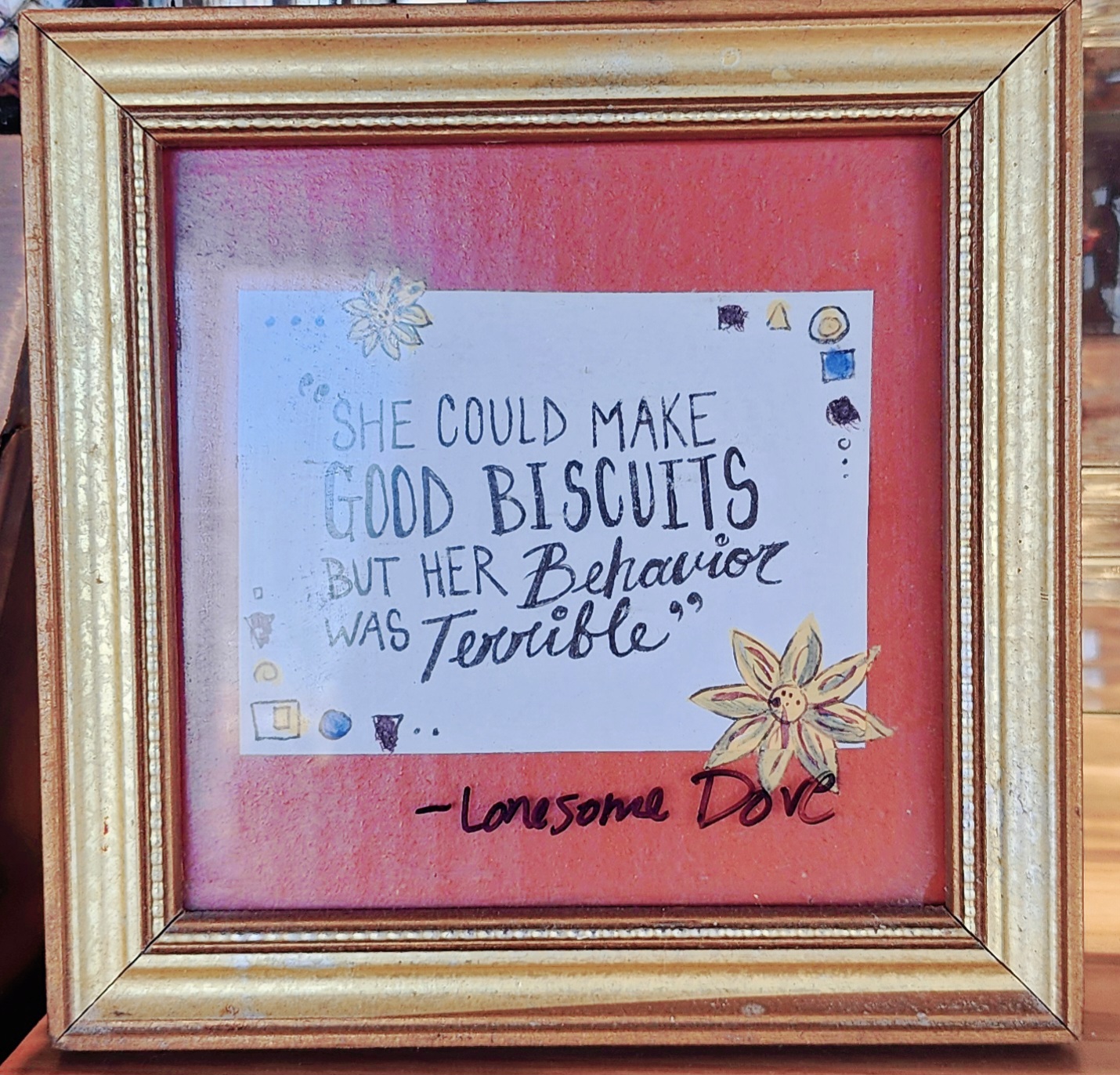
I was too caught up noticing this awesome tiny, framed quote by the display case. As a young reader I LOVED Larry McMurtry, see, who wrote Lonesome Dove and a whole lot more. He and I both went to UNT (decades apart, of course) where he gave us a wonderful author meet and greet (early 90s for me, when this kid was not even a twinkle). The coffee and pie shop had quite appropriately chosen to frame this gem of a quote: “She made great biscuits, but her behavior was TERRIBLE”.

My daughter and I were out doing a ritual Saturday thing. My mom used to sing “Come Saturday Morning” with me (we had the sheet music, so it was right up there with “Country Roads” and “The City of New Orleans” in my book). And sometimes we would spend time just us, and I would look at her hands and sing this song in my head. Saturday mornings, for a couple precious hours, are time when my daughter doesn’t have to share me with her little brother, and she pays me back by asking me questions I can’t answer. It’s at this time I learn that even 5 year olds wonder things about God and the universe, have nightmares, they can have crushes, they have fears, they might still want to hold my hand.

I LOVE biscuits but I love her even more. I love her more than her behavior, even that sort of behavior that makes you want to fire the babysitter just so you’ll never have to greet that face that saw the terrible behavior you thought your kid would never do in public and after all, you are a behavior analyst! (Do I think it’s easier because I’m a behavior analyst, my new friend asked recently? Heck no. I personally think it’s harder. But I do think being a parent has made me a better behavior analyst.)

So in relationships we do rituals, like setting up meaningful goodbyes when we leave the room, or when rhythms change and we won’t be spending as much time together anymore. If not, we leave devastation.

When I watch animals grieving each other’s deaths… especially horses and dogs… I notice how fully present they are for the goodbye.

And I am always grieved to consider the implication: such a meaningless slog of goodbyes without reason, or participation, we inflect this on clients when caseloads shift; when a therapist moves; when a client with certain behaviors moves into Hall B, so we just HAVE to abruptly move Client A into Hall D, so they won’t antagonize each other and never mind Client A will never again see her best friend client, or even the janitor—who was like a mother to her and had been there for 12 of the client’s 15 years in this mental facility again.

We often have to make hard decisions, but we should ask questions (“what really hurt your feelings this past week? Today?”) because in relationships we apologize when we’re wrong.

When we realize we hurt others, we shift so that we won’t keep doing the hurtful thing.

My mom remembered the pain of being hurried as a child. I knew that, and I forgot it. I remembered it again this month when I was going through an exercise I was making for a new workshop we will offer at cuspemergenceuniversity.com. The exercise has us grownups go through questions that reveal the triggers for us – the things in our everyday situations that make us more likely to react swiftly (often in a hurtful way) to the others around us. And I realized two things: being hurried doesn’t feel good to children, and hurrying children doesn’t feel good to adults. So what do we do? This week, maybe you will notice a ritual that is always done with urgency, and think, how does this feel? What would this feel like if I slowed down? Now, the harder part: What would it take for me to build in space around this… ten extra minutes before it, so that we don’t have to experience this, every single time, in hurried mode? I tried this, and my children really love it, although I won’t hear about it from them. Their lingering hugs (mama, don’t let go first!) and their wonder as we have time to look around the yard for a new flower before we buckle our seatbelts… the absence of urgent reminders and exasperated sighs… perhaps even a reduction in tense moments when I’m about to lose it and yell. These changes are rewarding enough for me to keep doing this. Because I love them more than biscuits.

Yes, rapport is often transactional. Although it was by design at first, it doesn’t always have to be that way. I talk about this just a little bit in my buffers article, in the relationship section. And in the trauma sensitivity course we talk a little about how to be more sensitive to what folks go through (including your staff) so that YOU can be a little less harsh, a little more supportive, around things you didn’t even realize were hurting the other person.

In relationships, we apologize; we give freely; we do things uncontingently (yes, I know you won’t be able to look that up, and there’s a reason- we talk about it more on instagram and it bears more attention); and we are generous with things the person really needs, like time, kind words, and those little rituals that they consider special. Have you ever worked with a therapist the client really adored? Or a professor beloved by their students? I remember two. The professor is loved and really loves. She gives generously of her wisdom, time, and appreciation for students. (You wanted to ace her class and reflect what you admired in her, even as she whispered the things that made you more of yourself, more creative and passionate and able to grow confidently in the direction of your dreams.) The other person I remember is a therapist who had kids riding on her shoulder at recess in our mixed school for kids with developmental differences and peers. And those folks taught me that you can have instructional control when it’s time, and still have fun with the people who look up to you. Rapport IS often transactional. But the relationship doesn’t have to be.

Thanks for reading.

Oh… and I personally think, in the Longmont area, that Lucille’s has the best biscuits.

And OhMeOhMyCoffeeAndPie has the best lemon bars, if you’re wondering.

I love you more than biscuits, daughter of mine. And I love you even when your behavior is terrible.

What are some relationships between buffers and triggers?

Featured

Posted by kolubcbad in adults, Autism, BACB CEU, CEU, children, Community, continuing education, Cusp Emergence University, CuspEmergenceUniversity, enriched environment, TI-ABA, TIABA, TIBA, trauma, trauma-informed behavior analysis, Uncategorized

≈ Leave a comment

Tags

autism, barriers, buffers, buffersandbarriers, children, cuspemergence, CuspEmergenceUniversity, family, kids, motherhood, parenting, parents, TIBA, trauma-informed behavior analysis, triggers

Another article in the TIBA series by Dr. Teresa Camille Kolu BCBA-D

In Chapter 8 of our course on Trauma Sensitivity, we cover the concept of “triggers” and what we can do about them. We cover this mostly from a responsive perspective in the course and use the following operational definition: “Triggers are historically meaningful stimulus complexes or relations between them. In their presence, behaviors or response patterns may be temporarily more likely to occur.” We continue with the big idea from Chapter 8 of that course, “One of the most supportive actions we can take is to stay mindful and do what needs doing in the moment”.

However, another huge thing we can do in helping someone through those triggering events or moments is to plan ahead. Below are some questions we ask our clients and their family members to answer, if they are interested in exploring this. Read on if you’re interested in some examples (we share a brief example of a dyad’s answers, where one member is the 5 year old kid, and the other is a parent). (Oh, and it may be helpful to check out the IPASS (find it in our RESOURCES tab)- this is a little tool we use for folks to go through their sensory environment for clues about triggers, if they need somewhere to start.)

Questions:

1.Name a person you love or a primary relationship you care deeply about.

2.Name an action that you do that shows compassion with them.

3.Name some things the person also does… that REALLY get under your skin.

4.Name an environmental situation or trigger that happens right before it is HARDEST to keep your cool.

5.List some things you start to notice when you’re feeling about to blow up/ lose your cool/ start doing actions that are inconsistent with your values to that #1 person.

6.State things you do to calm down in those moments that REALLY work or are most likely to work.

7.If you DIDN’T act to calm down and things kept getting worse, state the action(s) you would be likely to use next in the presence of that person.

Growth statement: Write your plan to prevent the triggers (3 and 4 above) from leading to actions that are inconsistent with your values (e.g., 7), by doing (6) as soon as you begin to notice things about your insides or the outside environment (5).

Ready to see this in action? Below are some parent answers. Keep in mind that neurodivergent parents often have neurodivergent children (or, looking backward, that neurodivergent children often have neurodivergent parents, whose qualities might not be appreciated until later, in the context of exploring diagnoses with their own children). Have you ever seen a mom struggling with her own misophonia exactly at the same time her child uses loud repetitive noises? Talk about triggering (for and to each other)! But stay hopeful and in the moment, because as hard as it is to be the thing in your loved one’s environment that sets them off, it’s lovely to be the person in their environment who can really understand where they’re coming from.

Parent Example: Answers to 7 questions, above

1.I love my kids.

2.I love it when I am able to use kind words and a calm voice with them.

3.Sometimes my kid makes repetitive noises, does not listen or interrupts me, or doesn’t follow instructions.

4.It is most difficult to keep my cool with my kids when I’m running late somewhere and my kid is not following instructions or is not doing something the “right” way.

5.I start to notice my face getting hot, my neck and face muscles are strained, and my breathing is shallow and fast. 

6.If I splash water on my face, relax my muscles, stop and hug my kid, and breathe deeply, it helps to calm me down in the moment.

7.If I skip that step above, I usually proceed to raise my voice and may even shout or say things I don’t mean (things that are not kind and compassionate).

Parent Growth plan: “When I’m late somewhere and it’s really noisy, it’s especially important that I start to notice when I’m using shallow breath, the noise around me is increasing, or I’m noticing everything “wrong” my kids do and nothing right they’re doing. Right then, before I talk to my kid, I need to immediately try some of my calming strategies I listed above.”

OK, now for the kid’s answers.

1.I love my mom and baby brother.

2.I love it when I am able to keep playing, share, have fun.

3.Sometimes my mom tells me to stop doing something I love or tells me how to do something better or my brother takes my stuff.

4.When mom yells or my brother takes my stuff or we have to leave my game or book, it is most difficult to keep my cool.

5.I start to notice my face getting hot, my movements are jerky, my chest hurts, and my breathing is fast. 

6.If I hug my mom, splash water on my face, stop and do some jumping jacks and then sit and breathe, it helps to calm me down in the moment.

7.If I skip that step above, I usually yell, hit my brother, or shout “NO! I WON’T!”.

Growth plan my parents can help with: When I’m being asked to stop playing or to do something that interrupts my flow, notice when I’m breathing faster and having a hard time talking. You can help by giving me a hug, doing some jumping jacks with me, and sitting with me and helping me to breathe.

At this point, we ask the parent some meaningful questions to help them make sense of what we’re noticing. And often this is uncomfortable (but becomes exciting and doable) as they first think, “oh, but won’t we be reinforcing escalation?” No, we’re turning it off.

Parents or caregivers, did you notice…

-Whether your having a hard time makes it harder for you to help your other person with THEIR hard time?

-Whether your hard time perhaps CONTRIBUTES to their hard time?

-Whether your triggers are echoed by the ones that seem to affect your kid or client? (e.g., are you teaching your other person to struggle with the same thing you struggle with, without your meaning for this to happen)?

-Whether your triggers might be easier to manage at a period of time when you (or both of you) are well fed, rested, and exercised?

Have you ever taken an on-demand workshop?

02 Thursday Mar 2023

Posted by kolubcbad in adults, Autism, BACB CEU, Behavior Analysis, Behavioral Cusp, boundaries of competence, CEU, children, collaboration, Community, continuing education, Cusp Emergence University, CuspEmergenceUniversity, supervision, teaching behavior analysis, teaching ethics, TI-ABA, TIABA, TIBA, trauma, trauma-informed behavior analysis, Uncategorized

≈ Leave a comment

Tags

BACB CEU, bacb ethics ceu, bacb supervision ceu, bcba-d courses, camille kolu, camille parsons, CuspEmergenceUniversity, ethics ceu, kolu, new course, on-demand workshop, supervision CEU, teresa kolu, trauma sensitivity, trauma sensitivity workshop, trauma-informed behavior analysis

For me, an on-demand workshop does several things: It can be taken any time; one can take it with a group and apply exercises with other people if desired; but since it’s on-demand, an individual will benefit even if taking it solo. It should be expandable if one wants to be able to sit with a chapter for a few extra hours because we simply love the content; there will be resources to grow with and come back to if one can’t do all the exercises right NOW. I’ve been on sabbatical a while; as I return to doing interviews, conferences, talks, and podcasts (including a new one we taped recently for the Atypical Behavior Analyst, with my friend Dr. Eddie Fernandez airing later), it is nice to be able to take something on my own time, when tiny folks are asleep, and I know many parents – and folks going through school and work at the same time – are in the same boat.

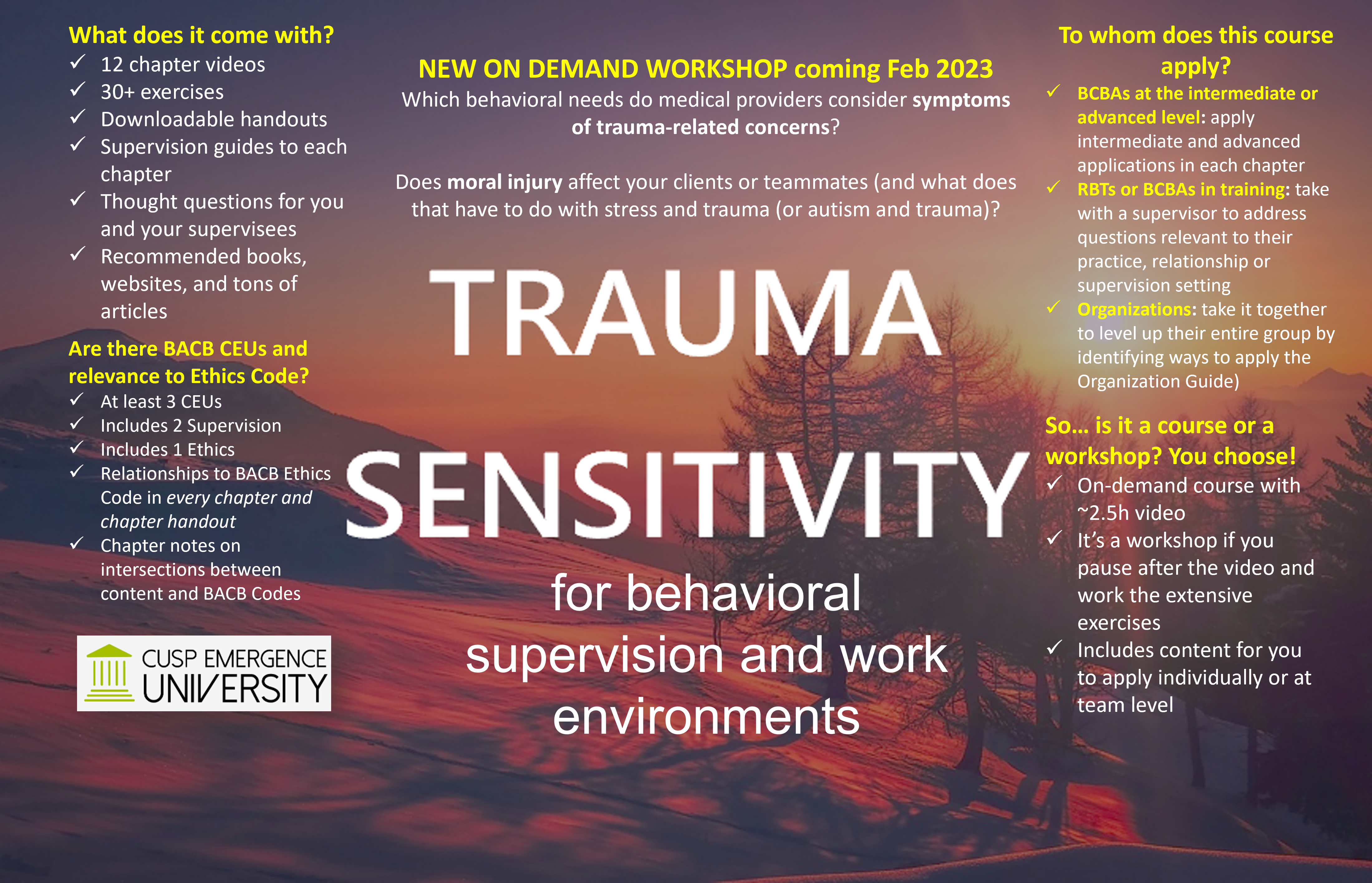
So after taking an on-demand online workshop recently, we decided to present some of our own new content in an expandable workshop format instead of the typical course, including several features. Our new Trauma Sensitivity workshop includes:

  1. 30+ exercises with the videos: Because this is an on-demand workshop, we present a TON of exercises packaged with the videos. Teams or individuals can easily do a chapter a week along with exercises for a truly transformative experience in your office or supervision setting. But if they choose to take it all at once in an afternoon, that’s possible too. So it’s customizable.
  2. Scalable applications for team members, supervisors and supervisees: The new content (on leveling up the trauma sensitivity of our staff and client environments) is “scalable”, meaning we include applications for 3 different levels of staff: those in roles that are basic; intermediate; and advanced. Presenting it as a workshop meant that the team members “leading” the discussions and exercises benefit just as much as (but different from) the less advanced team members they are mentoring through it.
  3. Supervision guides and chapter handouts: These come with every chapter video and walk the student through the material, from the main ideas we presented, to definitions for any new vocabulary, exercises, lists of Ethics Code items that relate, thoughtful discussion questions, exercises, and chapter resources and articles. Every chapter comes with its own handout and supervision guide to help BACB supervisors or team leaders support our coworkers and supervisees.

The two things I personally love most about this workshop are:

  1. it addresses tough topics like moral injury with your team members and considering how this ethics area could apply to our supervisees but our clients too;
  2. and we provide resources to follow up on big ideas like this one: there are some behavioral needs that medical providers consider symptoms of trauma-related concerns. (If folks are new to integrating trauma sensitivity in their supervision and client environments, we might miss this huge opportunity to make sure we do no harm by treating behavior needs that are actually related to new abuse.)

Wondering about the content of the new workshop? Here are the chapters (each has its own video, ethics intersections, resources, thought questions, and exercises):

Chapter 1: Principles of Trauma-Sensitive Care  
Chapter 2: Interactions that could help or do harm
Chapter 3: Features of trauma-related responding  
Chapter 4: Defining trauma  
Chapter 5: Risks related to trauma  
Chapter 6: Elements of a potentially trauma-related response  
Chapter 7: Buffers
Chapter 8: Triggers (Then watch integration Scenario Video)
Chapter 9: Neurodevelopment
Chapter 10: Want to mitigate risk? Document it first
Chapter 11: Skills and Stress
Chapter 12: Healthy Collaboration  
Above: Table of chapters from Trauma Sensitivity in the Behavioral Workplace, new on-demand workshop from Cusp Emergence

Did you enjoy this article? Come back soon when we’ll cover a few more related topics including: mentorship groups for those applying trauma sensitivity principles in their supervision sessions; how to get the most out of your workshop experience by doing exercises as a group or dyad; more info on a brand new all-trauma conference coming in April hosted by the formidable Dr. Gabi Morgan; meetups in Denver May 2023; and more!

Read below for final thoughts and some links if you’re in the market for values related CEUs: Recently, when my own CEU cycle was about to turn over, I knew it was time to take a course or workshop in something I could use NOW and am passionate about… so I went searching for three things: supervision CEUs; offerings from people I admire and from folks who literally wrote the books on leveling up mentorship and supervision and working with families; and opportunities to learn about values in a deeper way that would help me level up my own practice. That led me to a couple of great courses and podcasts; one of these opportunities was a workshop with built in exercises that could be taken quickly or over the course of a few weeks and included opportunities to network with other folks. It was a really lovely experience. Included are links to a couple trainings and podcasts from respected folks who continue to inspire, below.

https://podcasts.apple.com/us/podcast/the-journey-of-supervision/id1501568747?i=1000485543749

https://evelyngouldphd.com/news/events/20220915-acting-on-a-value-of-self-care-on-demand/

https://www.weareconstellations.com/current-workshops

And here’s the trauma sensitivity on-demand workshop: https://www.cuspemergenceuniversity.com/courses/trauma-sensitivity

New 4h course: Autism, TIBA and Ethics

02 Wednesday Feb 2022

Posted by kolubcbad in Autism, BACB CEU, Behavior Analysis, behavior cusp, CEU, collaboration, continuing education, contraindicated procedures, Cusp Emergence University, CuspEmergenceUniversity, ethics, Fetal Alcohol Spectrum Disorders, Uncategorized

≈ Leave a comment

Tags

autism, behavior analysis, ethics, TIBA, trauma, trauma informed behavior analysis

Last time I wrote, I shared some ideas about this intersection. Today, the new course is up! Before you go check it out (and claim your February 2022 coupon for 20% off by typing ASD2022)– during the introductory month of the course)- learn why I’m so passionate about screening for trauma in a population so many behavior analysts have been working with (for some, virtually their entire professional lives).

Have you ever worked with someone in pain? How do we know if they’re currently hurting, whether it’s because they are sick, it’s related to interventions we chose, or from experiences we reminded them of? How would we know if that was the case? Did that person cower, freeze, or grimace? Did they flinch, close their eyes, seem to “zone out”? Perhaps someone has run away, played repetitively with the toys they had, or fallen asleep at school? Sometimes, respondent behaviors may be giveaways that people are experiencing fear or in pain, but successful avoidance behavior can hide that pain. Other times people have been through experiences making them more likely to use aggression or property destruction. In the least, we should consider whether our interventions cause harm. This harm could include causing our clients distress or pain, exposing someone to additional risks, detracting from their quality of life, failing to program in sustainable ways that transfer to the maintaining environment, and so much more.

A new training is up on Cusp.University on the intersection of autism, trauma informed behavior analysis, and ethics. By the time we near the end, we have discussed and revisited the idea of contra-indicated procedures. Given that lists exist for diagnoses of autism alone, why isn’t there a list of best practices appropriate for clientele meeting diagnostic criteria for autism who also come to therapy with trauma histories? Why is it so difficult to find articles suggesting best treatment paths for individuals with both autism and trauma related experiences in the literature? In behavior analysis, answers to these questions may be related to our field, its historical publishing practices, and the ethical and pragmatic need to individualize procedures for each client.

In terms of publishing practices, a panelist in ABAI’s “Exploring Publication Bias in Behavior Analytic Research” (which included Galizio, Travers, and Ringdahl, 2021) stated,

“No intervention is guaranteed to work for every individual, every time, in every context.”

They suggested that authors writing about their research should include more detailed descriptions of the conditions under which successful implementation of the intervention occurred.

When we screen for trauma related or aversive historical situations and stimuli, we often learn things that

  • help us prioritize treatment,
  • document risks for certain procedures,
  • avoid or prioritize certain stimuli,
  • detect environmental conditions that are acting as motivational operations and conditioned MOs,
  • and ultimately, perhaps minimize harm to our client.

Screening for trauma can help to identify individuals with prior risk factors who are at risk for experiencing additional adverse events and aversive conditioning. Attendees learn in chapter 1 some facts about how being autistic is to be at increased risk for trauma, bullying, abuse, increased likelihood of experiencing foster care—and in chapter 3, learn about the higher rates of experiencing restraint, seclusion and being excluded from school.

But another effect of screening – one that should affect all behavior analysts—could be an increased awareness of the fact that behavior analytic procedures are being used all the time for this population at the intersection of autism and trauma. Perhaps the least we can do is to begin doing behavior analysis with people instead of to people, and to be transparent, inviting, and open in looking at options—and their likelihood of causing harm either now in the future.

Let’s look at this juxtaposition: we have a great ethical responsibility to do no harm, but also an ability to cause great harm. With using any behavioral procedure there comes a risk that we may do just that. This is especially true when we don’t have literature evidence that a given intervention is appropriate and effective for the person’s needs given their history and current situation. Perhaps they don’t actually need behavior analysis seeking to change their behavior as much as they need a roof, a meal, a bus pass, a blender, a respite provider, a ride to the doctor, a coat, a medication, a trip to the dentist… the list could go on and on. So clearly the first step is to see what the person needs.

When designing an individualized behavior support plan, two things are important to consider:

(1) the risks and benefits for the client themselves, given their needs, values, environment, etc., (e.g., the long- and short-term outcomes of procedures and decisions, and

(2) evidence the procedure is appropriate for our client.

In terms of evidence, when considering decisions in context of the literature, few studies provide sufficient detail in characteristics of the participants. So it is difficult to tell, reminds the panel, which characteristics were present for study participants received successful or unsuccessful interventions. Thus we can’t really tell how many of the massive number of papers on treating behaviors in autism, also apply and were conducted with individuals with autism who also had a trauma background. But statistics suggest many of them must have. In the science of behavior analysis, each subject’s behavior is its own control, so if we control our conditions and try to measure well, we may reveal additional elements of historical and current behavioral environments that exert contextual and stimulus control on the client’s behavior- and that change their needs. At times, historical aversive conditioning experiences may have contributed changes making it painful or inappropriate for clients to experience certain interventions. As we discuss in the new training, some of those conditioning experiences may even have occurred during and as part of behavioral treatment.

We can’t know for sure what our clients have been through. But when owe it to them to honor those experiences if they are comfortable sharing them.

Here are some of the things you’ll learn.

Course Objectives: 

1. List connections between autism and trauma in the research 

2. State different kinds or examples of trauma that may affect individuals with autism 

3. State supportive ways to ask about trauma histories

4. Select examples of how medical history can be related to trauma

5. State examples of repertoires beneficial for practitioners who serve clients affected by both autism and trauma

Ready to learn more? The new training offers hints from Dr. Kolu on how we begin the conversation about informed consent and screening for trauma, why assent is so important, how trauma and autism might intersect with medical needs affecting our clients, and more. And all the resources are available as free content in the preview section, so go grab that now! See you at a conference soon or find us online. And thank you for listening!

Get ready to learn about ASD and trauma

11 Monday Oct 2021

Posted by kolubcbad in adults, Autism, BACB CEU, Behavior Analysis, behavior cusp, Behavioral Cusp, CEU, children, collaboration, Community, continuing education, contraindicated procedures, Cusp Emergence University, CuspEmergenceUniversity, Education and Trauma-Informed Behavior Analysis, learning, podcast, resources, risk analysis, risk assessment, risk versus benefit analysis, TI-ABA, TIABA, TIBA, trauma, trauma-informed behavior analysis

≈ Leave a comment

Tags

podcast

By Dr. Camille Kolu, Ph.D., BCBA-D

Behavior analysts who treat people with autism probably know that ASD often co-occurs with trauma. But did you know that up to 50 percent or more of people with autism may have experienced trauma, that ASD itself is a risk factor for experiencing trauma, or that children with autism may be around 2.5 times more likely to experience foster care, itself another risk factor for trauma?

These findings are some of the reasons researchers (as well as research-practitioners, including those of us at Cusp Emergence) urge practitioners to adopt screening in order to support the huge group of people affected by both trauma and ASD (see Brenner, Pan and Mazefsky et al. on the need for screening, and special behavioral differences that occur in this population).

ASD and TIBA: Our newest upcoming course on CuspEmergenceUniversity.com

They are also just a few of the things you’ll learn when you take the upcoming course on CuspEmergenceUniversity on trauma and autism (coming Fall 2021). Other topics we cover include:

-client examples from both child and adult populations whose experiences include autism and trauma

-literature references helping practitioners discover more about what trauma related experiences people with autism may face

-how behaviors themselves can be risk factors for additional trauma

-behavior programming examples that may be counterindicated procedures depending on the individual needs of autistic people who faced trauma

-examples of ASD communication needs that have been particularly helpful to target when supporting this population after trauma

-behavioral cusps that can make a huge difference after trauma

-examples of worst case scenarios people face when trauma history is not taken into account for individuals with autism after trauma….

…and much more. We also cover how Cusp Emergence uses the SAFE-T model and Assessment (including our risk versus benefit tools) to be more supportive, mitigate risks unique to autism and trauma, and learn more about the whole person and their needs.

Just can’t wait for the CEU course on autism and trauma to be posted in the coming months? Tune in to The Autism Helper’s podcast. Dr. Kolu’s interview with Sasha Long, BCBA is live and we’re excited to share it with you!

25 Things I Want You to Know: Ways I use trauma to inform my practice of behavior analysis

26 Thursday Aug 2021

Posted by kolubcbad in adults, Autism, BACB CEU, Behavior Analysis, boundaries of competence, CEU, children, collaboration, Community, continuing education, contraindicated procedures, Cusp Emergence University, CuspEmergenceUniversity, Education, mental health, resources, risk versus benefit analysis, TI-ABA, TIABA, TIBA, trauma, trauma-informed behavior analysis

≈ Leave a comment

Tags

behavior analysis, TIBA, trauma, trauma and behavior analysis, trauma-informed behavior analysis

This is the 21st article in a series on Trauma-Informed Behavior Analysis by Dr. Camille Kolu, BCBA-D

I often hear from educators and behavior analysts, “What do you actually do differently if your client has faced trauma, given your role as a behavior analyst?” In this bulleted series we’ll get there, but we’ll start with what I would want you to understand about myself as your client (or teammate!) who has experienced adverse experiences. Here we list 25 different things I want you to know. (As a hint, each thing we can understand about a person could be a bridge, if you choose to walk through this difficult thing to a shared place of understanding on the other side. We’ll explain in more detail in future posts, or you can check out our course library over at CuspEmergenceUniversity if you’re interested in expanding your boundary of competence). But first, if I were your client or team member – if my past involved trauma – I would want you to understand that now, with the presence of historical trauma,

I MAY:

  • have difficulties calming down when under pressure
  • have difficulties using “appropriate” behaviors even after years of programmed reinforcement for using them
  • have mental health concerns that have never been appropriately addressed because my behavior masks my needs
  • have medical problems that are going unaddressed because my providers have never asked me about my trauma history, despite it being a fact that it confers serious medical risks. (See the incomparable Nadine Burke Harris talk about her work on this, and the amazing takeaways, in her classic TED Talk– or see some of her research and outcomes on using screening tools)
  • be more likely to use certain “challenging behaviors”
  • and find it more reinforcing, even important, to use behaviors you would describe as challenging
  • use behaviors that are more resistant to change than you are used to as an instructor, therapist, parent, supervisor or friend
  • find certain interventions painful, difficult, or harmful
  • find some kinds of social interactions difficult or painful
  • have trouble controlling some of my bodily functions, but may not be able to describe to you why
  • experience “triggers” in the environment that you can’t see (but that an experienced provider could locate, document, and learn to help me explore or move with, as appropriate)
  • experience some times of the day, week, month, or year that are marked by aversive events for me that you won’t know about
  • may not be able to explain WHY this time is difficult or why I am using an “old pattern of behavior”
  • find it more difficult to perform, or to learn and remember new things than others of my age, skill level, or occupation – even if “on a good day” I can do this just fine. (By the way, have you read The Four Agreements? Do you know how important it is to take nothing personally and know that others are doing their best (and how critical it is for you to do the same)? If not go check it out.
  • use occasional behavior that is mistaken as “ADHD” or “ODD”, or more, but that is actually related to how I was mistreated
  • have been given misdiagnoses, treatments that didn’t work, or medications that made my problems worse or that interacted with each other in harmful ways that hurt my body and cognitive function
  • attempt to advocate but get ignored when I try to communicate pain, mistreatment, or a medical concern
  • be more likely to experience FUTURE trauma because of what I faced before
  • lack a reinforcing and useful repertoire (e.g., full complement of skills and things to enjoy), especially if I faced treatments that just tried to “teach me a replacement behavior” for a few challenging things I did, instead of understand and grow me as a person in the context of my own community, needs and desires for my future
  • be part of a long line of marginalized people or one of multiple generations exposed to trauma
  • have a chance to change our lineage… if you help

After all, I AM:

  • a human being with interests, feelings, and great potential for growth and joy
  • more likely to experience certain risks (I may be at greater risk of losing my educational or therapeutic setting, go through harmful discipline practices, be exposed to law enforcement interaction, for example)
  • in need of understanding, an informed supervisor and system of support, and someone who will document my challenges so we can work on them, but not emphasize them so much they ignore my strengths, needs and skills
  • capable of much more on my best day than I show on a hard day… but I am always doing “my best” at the time, given what I have been through and what I AM going through, and despite what it looks like

Taking these points as a starting place, future posts in this series explore what I NEED as a person who may have faced these things, and what I DO as a behavior analyst who cares. We’ll also share some of what I need from my supervisors or systems administrators! What would you add to this list? What are some of your action items?

Self-paced SAFE-T Assessment Training is here!

16 Tuesday Feb 2021

Posted by kolubcbad in adults, Autism, BACB CEU, Behavior Analysis, behavior cusp, Behavioral Cusp, CEU, children, collaboration, Community, continuing education, contraindicated procedures, Cusp Emergence University, CuspEmergenceUniversity, Education, ethics, mental health, resources, risk analysis, risk assessment, risk versus benefit analysis, supervision, teaching ethics, TI-ABA, TIABA, TIBA, trauma, trauma-informed behavior analysis, Uncategorized

≈ Leave a comment

Tags

behavior analysis, behavior analysis CEU, CEU, continuing education, cuspemergence, CuspEmergenceUniversity, ethics ceu, SAFE-T, SAFE-T Assessment, SAFE-T model, SAFET Model, supervision CEU, TI-ABA, TIABA, TIBA, trauma, trauma CEU, trauma-informed behavior analysis

It’s finally here! We have learned so much from workshop attendees, trainees and supervisees in this area over the past several years, and appreciate the attendance, feedback and support of everyone who has taken the training or used a version of the SAFE-T Assessment. Coming on Monday, the booklet and training for assessing trauma-related factors affecting our clients of behavioral services, are available ONLINE as a self-paced course. This course provides a download of the new and expanded SAFE-T Checklist booklet, which contains several tools enabling the screening and documentation of over 200 trauma-related factors, and a Risks and Needs form to help teams understand (and document) how these factors confer risks (and converge in risk factors that must be solved or mitigated to protect our clients, teams, and ourselves). The booklet contains an extensive reference section and team supportive tools as you use your new knowledge to better align your team’s skillset with the Ethics Code, and the individualized needs of behavior services clients after trauma.

Several of our behavior analytic and collaborator clients across institutions, educational facilities and private companies clients have shared that learning to assess risk factors related to trauma, and to apply this information to their teams’ FBAs and risk mitigation plans, took their skillset to the next level – essentially affording them an opportunity to acquire an important behavioral cusp for their teams.

Some new components of the booklet include:

  • An optional buffer/ resilience score to assess whether protective environmental and therapeutic components of a client’s plan are in place (to understand some ways that trauma gives rise to medical and behavioral challenges and some buffering factors that can help, please see the book or scholarly articles by Dr. Nadine Burke Harris (e.g., Oh D.L. et al. 2018), who is the Presidential Scholar for 2021’s upcoming Association for Behavior Analysis International’s conference. She will address the critical topic of breaking the intergenerational cycle of adversity, and screening for ACES (adverse childhood experiences).
  • Table of potentially contraindicated procedures (cross referenced with items and risk clusters assessed in the Risks and Needs form)
  • Information about over 50 risk clusters (groups of related risks in the 6 assessed sections of the SAFE-T Assessment)
  • Cross-reference tables showing, for each item we screen for, the location(s) in the SAFE-T Checklist
  • Infographic on components of a trauma-informed FBA
  • Brief templates for Risk Versus Benefit Analysis and Risk Mitigation Planning
  • The IPASS (Inventory of Potential Aversive Stimuli and Setting Events) tool and instructions
  • References (organized by topics) covering over 40 areas or topics of literature related to trauma (including relationships of ACES to medical problems, ACT and intellectual disability, ACT and anxiety, foster care and adoption, the relationship of abuse to pain, drug use and trauma, and much more).

Time required: The course includes about 4.5 hours of video content in 12 lessons, each followed by a brief quiz.

Price (includes 4.5 CEU course and SAFE-T Assessment booklet download): $189.99

For $20 off through the end of February, use the coupon code “SAFET20”.

To register: cusp.university

Connecting Behavior Analysis, Aging, Trauma, and Supervision

18 Monday Nov 2019

Posted by kolubcbad in adults, BACB CEU, Behavior Analysis, boundaries of competence, CEU, collaboration, Community, continuing education, Cusp Emergence University, dementia, ethics, mental health, supervision, teaching behavior analysis, TIBA, trauma, trauma-informed behavior analysis

≈ Leave a comment

Tags

aging, gerontology, janet ellis, trauma, trauma-informed behavior analysis

Behavior Analysis, Aging, Trauma, and Supervision (or BATS, in honor of Dr. Janet Ellis).

This is the 18th article in a series on Trauma-Informed Behavior Analysis by Dr. Camille Kolu, BCBA-D. It includes something new that we have been asked about: Companion notes for students and supervisees working through this information with the support of their supervisor.

I heard Jon Baker give a great talk on advances in behavioral treatment of gerontology the other day at COABA. It made me think of my students at the University of Colorado Denver and our supervisees. (There was also a fantastic talk on supervision and feedback by the incomparable Ellie Kazemi, whose book on supervision is out now). When they ask about clients other than autism who have benefited from applied behavior analysis, my supervisees are usually excited to read stories in which ABA changed the lives of people with dementia, brain injury, medical needs, and more. For example, an article from Baker (2006) Continue reading →

Seeing Snakes and Spiders

27 Friday Sep 2019

Posted by kolubcbad in BACB CEU, Behavior Analysis, boundaries of competence, CEU, children, collaboration, Community, continuing education, Cusp Emergence University, CuspEmergenceUniversity, edtiba, EDTIBA10, Education, Education and Trauma-Informed Behavior Analysis, ethics, mental health, resources, sale, teaching behavior analysis, teaching ethics, TIBA, trauma, trauma-informed behavior analysis, Uncategorized

≈ Leave a comment

Tags

ABA, continuing education, CuspEmergenceUniversity, edtiba, ethics, events, mental health, resources, trauma-informed behavior analysis

This is the 17th article in a series on Trauma-Informed Behavior Analysis by Dr. Teresa Camille Kolu, Ph.D., BCBA-D.

spider

What did you do when you saw this picture? Chances are you experienced some additional events beyond just “seeing it”. Did you jump? Experience an increase in your breathing rate? Use some choice verbal behavior? Avert your eyes? (And are you prepared to read on? Fair warning… there’s a snake coming up).

Seeing with fresh eyes

I noticed a couple of things about our culture, and fear responses, this past week.

My young daughter’s love for flap books—the kind where you pull back a piece of paper to reveal something—knows no bounds. So she was instantly drawn to a tattered old library copy (apparently she shares this love with lots of peers) of “Buzz Buzz, Baby”- with poorly rendered babies exploring “bugs”. Around the third page the baby pulls back a web flap to unveil, in the book’s words, “EEK! The itsy bitsy spider!”

Whenever I read the book to her I leave out the “Eek!”.

I think she can come up with that on her own, if she happens to, although chances are she’ll get it from me in a non-mindful moment. (In the 1980’s Cook and Mineka did a classic study in which infant monkeys “acquired” a persistent fear of snakes by watching their scared mothers encounter a snake).

Now that we’ve moved out to the country, we encounter our own “Itsy” (and many for whom that name is woefully inadequate) all the time. (I do recommend this thing called the BugZooka… it does work really well, if you like catch-and-release). Itsy and I go way back, and not necessarily in a good way, although I always appreciate her beauty. But I still want to be warned before you text me her picture, dad.

This summer, one tenacious spider (pictured, top) built a web, over and over, in a windy area outside the kitchen, where we see it numerous times daily. The first few (ok, few hundred) times I nearly jumped out of my skin. When I remembered in time, I was very careful to breathe and compose myself before walking to the sink with my daughter, where I’d point out the spider cheerfully and sing (with all the hand movements) the requisite song. Before long she was signing the song herself. Next I noticed myself no longer jumping when I saw the spider.

THEN… one windy morning Itsy was gone. Gone!

I didn’t breathe a sigh of relief.

I was surprised and curious to feel a strange emotion… like MISSING. I missed her! Was she alright? Would she come back? (She was. She did).

With painful awareness that this is temporary, I often marvel that my daughter’s eyes are not only young… they are unconditioned. They don’t have a lot of pairings with events like scary movies about this deep primate fear, being bitten, or seeing spiders while a parent jumps and screams. They are fresh, curious, hopeful eyes.

Yesterday we chanced upon something rather larger than even the biggest spider. It was this old girl… fat and long, with ring upon ring adorning her useful brown rattle. Depending on my readers, maybe you’ll be happy that instead of grabbing a hoe, I called a guy I read about in my new community’s online forum… apparently this guy LOVES snakes. “ANY snake’s worth my time”, he told me as he jumped in his truck. 35 minutes later he had driven up to our homestead, hooked it and taken it. Now it’s in a quite different rattlesnake heaven than the kind I had sort of planned to send it… blissing out in a protected wilderness area up near Fort Collins, I’m told.

rattler

As he removed our snake into a large vented box and curiously counted the rings (while remarking on how huge it was), the guy’s face was composed; he exuded a strange calm excitement. Normally, the fear response to snakes and spiders is part of our biology. Evolutionary biology has several theories why it’s present even in infancy, and why it might have behooved our ancestral mothers to experience more arousal and get out of there to protect their young in the presence of these critters. I can’t help but wonder what this guy’s history is like. Why does he love something that most of us are scared of?

Kids with traumatic histories

If you’re an educator going back to school, many of your kids are coming in with an avoidance response, or a “get out of there!” escape response, ready to go. Some of them will use these responses in the most annoying ways, dropping all their work on the floor or crawling under desks when you announce the quiz. But some of them have a special background you can’t see. For some, they will use these “fear responses” when they encounter “triggers” that you and I do not think of as scary.

Why is that?

Well, the things that were there when they experienced really bad situations are now “paired”, living together in their past, the same way I smelled an old lady yesterday wearing my own granny’s soap and got emotional thinking about my dear departed loved ones. Or the same way you hear a certain song from your high school dance and think about that year, or that person, or that kiss.

And that’s not all. Psychology explains in anxiety journals why, if you’re a person with an intense “fear” or phobia of spiders, not only do you spot them more quickly and tend to see them where your peers might see other things, like mushrooms or flowers faster in the SAME PICTURE—but to you, they also appear BIGGER.

What can we do about it?

How can we help students show up for their education and get all the learning opportunities they can… even when the school, teachers, and peers accidentally give them “fear related” stimuli all day long? (While psychology explains partly WHY these pairings happen, behavior analysis does too, especially if you read some relational frame theory, learn about respondent conditioning, and take a long-term functional analytic approach. Behavior analysis also goes a long way in helping the helpers undo some of the damage, teaching kids to approach adults and “unpair” adult attention from it’s previously bad parts: if I’m a student who has been through neglect abuse, my teacher coming over to me to praise my “good behavior” might not be a welcome stimulus at first… and my teacher’s praise, as well-intentioned as it may be, might not work).

Cusp Emergence University has been hard at work getting the new online training course ready for educators, and behavior analysts who work in education. We hope to help you to start answering these questions for yourself and your students and teams. On Monday, September 30, our course “Education and Trauma-Informed Behavior Analysis” opens to a 7 day sale (use the code EDTIBA10 for 10 percent off this CEU opportunity). We’re providing BCBA’s and BCBA-D’s with 3.5 continuing education credits, and 3 of those are in ethics.

coupon

Sign up now!

Recent Posts

  • Lessons from a Lost Balloon: Growth, Safety, and Kindness
  • Behavioral Seismology
  • 10 Actions This Year: A call-in if you read Boggs et al. (2025)
  • Understanding Values: The Connection to Context and Action
  • I love you more than biscuits

Archives

  • July 2025
  • May 2025
  • November 2024
  • February 2024
  • June 2023
  • April 2023
  • March 2023
  • October 2022
  • February 2022
  • October 2021
  • August 2021
  • February 2021
  • September 2020
  • May 2020
  • March 2020
  • November 2019
  • September 2019
  • June 2019
  • January 2019
  • November 2018
  • October 2018
  • September 2018
  • July 2018
  • May 2018
  • April 2018
  • March 2018
  • February 2018
  • October 2017
  • September 2017
  • August 2017
  • July 2017
  • May 2016
  • September 2014
  • July 2013
  • June 2013
  • May 2013
  • April 2013
  • March 2013
  • February 2013
  • January 2013
  • December 2012
  • November 2012
  • October 2012
  • August 2012

Categories

  • About
  • acquisition
  • adults
  • Autism
  • BABA
  • BACB CEU
  • Behavior Analysis
  • behavior cusp
  • Behavioral Cusp
  • boundaries of competence
  • buffers and barriers
  • CASA
  • CEU
  • children
  • collaboration
  • Community
  • conferences
  • contextual fear conditioning
  • continuing education
  • contraindicated procedures
  • coronavirus
  • Court Appointed Special Advocate
  • Covid-19
  • Cusp Emergence University
  • CuspEmergenceUniversity
  • data
  • dementia
  • Early Intervention
  • edtiba
  • EDTIBA10
  • Education
  • Education and Trauma-Informed Behavior Analysis
  • elopement
  • Emergence
  • enriched environment
  • ethics
  • extinction
  • FAS
  • FASD
  • Fetal Alcohol Spectrum Disorders
  • flood
  • functional alternative behavior
  • hospital
  • hurricane
  • job aids
  • learning
  • mental health
  • Neuroscience
  • play
  • podcast
  • praise
  • RAD
  • reactive attachment disorder
  • renewal effect
  • resources
  • Rett's
  • risk analysis
  • risk assessment
  • risk versus benefit analysis
  • safety skills
  • sale
  • schedules of punishment
  • self injurious behavior
  • Social Interaction
  • stimulus schedules
  • supervision
  • teaching behavior analysis
  • teaching ethics
  • TI-ABA
  • TIABA
  • TIBA
  • trauma
  • trauma-informed behavior analysis
  • Uncategorized
  • variability

Meta

  • Create account
  • Log in
  • Entries feed
  • Comments feed
  • WordPress.com

Blog at WordPress.com.

  • Subscribe Subscribed
    • Cusp Emergence
    • Join 121 other subscribers
    • Already have a WordPress.com account? Log in now.
    • Cusp Emergence
    • Subscribe Subscribed
    • Sign up
    • Log in
    • Report this content
    • View site in Reader
    • Manage subscriptions
    • Collapse this bar
 

Loading Comments...