
• TIBA (Trauma-Informed BA) articles
  • Cusp Emergence in the Community
  • About Cusp Emergence
  • About Dr. Kolu
  • ETHICS
  • Cusp Emergence University
  • Resources
  • Mentorship
  • Buffers
  • Behavioral Seismology: Predicting Behavioral Needs During Hormonal Changes

Cusp Emergence

~ Collaborating ~ Consulting ~ Constructing Repertoires

Cusp Emergence

Tag Archives: parenting

I love you more than biscuits

Featured

Posted by kolubcbad in adults, Autism, Behavior Analysis, children, Community, Cusp Emergence University, CuspEmergenceUniversity, TI-ABA, TIABA, TIBA, trauma, trauma-informed behavior analysis, Uncategorized

≈ Leave a comment

Tags

love, mental health, parenting, relationship, relationships

Another article in the trauma-informed series by Dr. Teresa Camille Kolu, Ph.D., BCBA-D

In relationships we do rituals.

“BLECH!” Startled, I looked down at my sweet, expressive daughter with a true disgust face. Everybody laughed. I was kinda mortified but I laughed too. The woman at MeOhMyCoffeeAndPie (you HAVE to go) had just answered her question with “it’s sauteed onion” when my kid asked “what’s the scone flavor today?”

Ok, I guess she wasn’t expecting that.
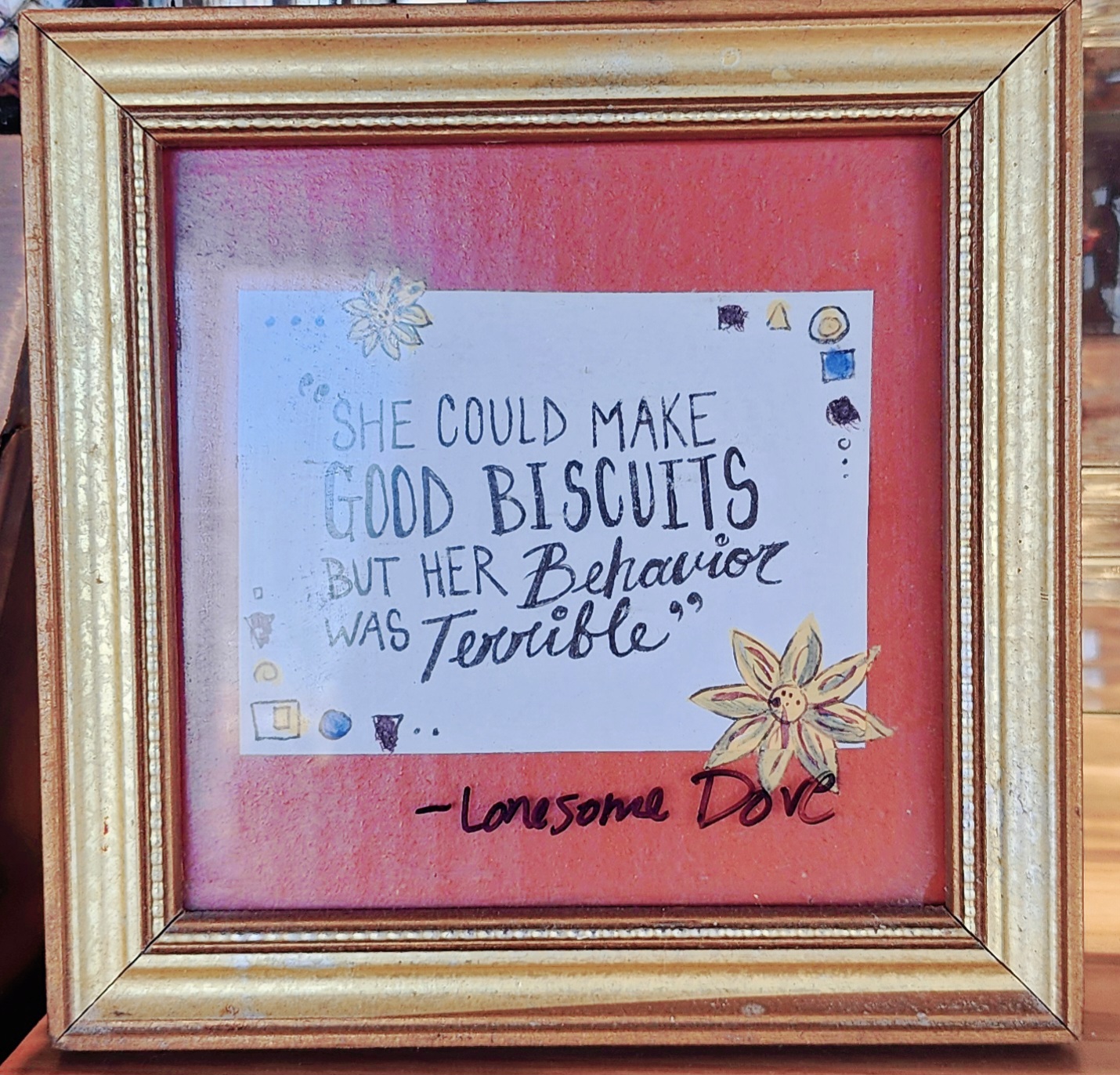
I was too caught up noticing this awesome tiny, framed quote by the display case. As a young reader I LOVED Larry McMurtry, see, who wrote Lonesome Dove and a whole lot more. He and I both went to UNT (decades apart, of course) where he gave us a wonderful author meet and greet (early 90s for me, when this kid was not even a twinkle). The coffee and pie shop had quite appropriately chosen to frame this gem of a quote: “She made great biscuits, but her behavior was TERRIBLE”.

My daughter and I were out doing a ritual Saturday thing. My mom used to sing “Come Saturday Morning” with me (we had the sheet music, so it was right up there with “Country Roads” and “The City of New Orleans” in my book). And sometimes we would spend time just us, and I would look at her hands and sing this song in my head. Saturday mornings, for a couple precious hours, are time when my daughter doesn’t have to share me with her little brother, and she pays me back by asking me questions I can’t answer. It’s at this time I learn that even 5 year olds wonder things about God and the universe, have nightmares, they can have crushes, they have fears, they might still want to hold my hand.

I LOVE biscuits but I love her even more. I love her more than her behavior, even that sort of behavior that makes you want to fire the babysitter just so you’ll never have to greet that face that saw the terrible behavior you thought your kid would never do in public and after all, you are a behavior analyst! (Do I think it’s easier because I’m a behavior analyst, my new friend asked recently? Heck no. I personally think it’s harder. But I do think being a parent has made me a better behavior analyst.)

So in relationships we do rituals, like setting up meaningful goodbyes when we leave the room, or when rhythms change and we won’t be spending as much time together anymore. If not, we leave devastation.

When I watch animals grieving each other’s deaths… especially horses and dogs… I notice how fully present they are for the goodbye.

And I am always grieved to consider the implication: such a meaningless slog of goodbyes without reason, or participation, we inflect this on clients when caseloads shift; when a therapist moves; when a client with certain behaviors moves into Hall B, so we just HAVE to abruptly move Client A into Hall D, so they won’t antagonize each other and never mind Client A will never again see her best friend client, or even the janitor—who was like a mother to her and had been there for 12 of the client’s 15 years in this mental facility again.

We often have to make hard decisions, but we should ask questions (“what really hurt your feelings this past week? Today?”) because in relationships we apologize when we’re wrong.

When we realize we hurt others, we shift so that we won’t keep doing the hurtful thing.

My mom remembered the pain of being hurried as a child. I knew that, and I forgot it. I remembered it again this month when I was going through an exercise I was making for a new workshop we will offer at cuspemergenceuniversity.com. The exercise has us grownups go through questions that reveal the triggers for us – the things in our everyday situations that make us more likely to react swiftly (often in a hurtful way) to the others around us. And I realized two things: being hurried doesn’t feel good to children, and hurrying children doesn’t feel good to adults. So what do we do? This week, maybe you will notice a ritual that is always done with urgency, and think, how does this feel? What would this feel like if I slowed down? Now, the harder part: What would it take for me to build in space around this… ten extra minutes before it, so that we don’t have to experience this, every single time, in hurried mode? I tried this, and my children really love it, although I won’t hear about it from them. Their lingering hugs (mama, don’t let go first!) and their wonder as we have time to look around the yard for a new flower before we buckle our seatbelts… the absence of urgent reminders and exasperated sighs… perhaps even a reduction in tense moments when I’m about to lose it and yell. These changes are rewarding enough for me to keep doing this. Because I love them more than biscuits.

Yes, rapport is often transactional. Although it was by design at first, it doesn’t always have to be that way. I talk about this just a little bit in my buffers article, in the relationship section. And in the trauma sensitivity course we talk a little about how to be more sensitive to what folks go through (including your staff) so that YOU can be a little less harsh, a little more supportive, around things you didn’t even realize were hurting the other person.

In relationships, we apologize; we give freely; we do things uncontingently (yes, I know you won’t be able to look that up, and there’s a reason- we talk about it more on instagram and it bears more attention); and we are generous with things the person really needs, like time, kind words, and those little rituals that they consider special. Have you ever worked with a therapist the client really adored? Or a professor beloved by their students? I remember two. The professor is loved and really loves. She gives generously of her wisdom, time, and appreciation for students. (You wanted to ace her class and reflect what you admired in her, even as she whispered the things that made you more of yourself, more creative and passionate and able to grow confidently in the direction of your dreams.) The other person I remember is a therapist who had kids riding on her shoulder at recess in our mixed school for kids with developmental differences and peers. And those folks taught me that you can have instructional control when it’s time, and still have fun with the people who look up to you. Rapport IS often transactional. But the relationship doesn’t have to be.

Thanks for reading.

Oh… and I personally think, in the Longmont area, that Lucille’s has the best biscuits.

And OhMeOhMyCoffeeAndPie has the best lemon bars, if you’re wondering.

I love you more than biscuits, daughter of mine. And I love you even when your behavior is terrible.

What are some relationships between buffers and triggers?

Featured

Posted by kolubcbad in adults, Autism, BACB CEU, CEU, children, Community, continuing education, Cusp Emergence University, CuspEmergenceUniversity, enriched environment, TI-ABA, TIABA, TIBA, trauma, trauma-informed behavior analysis, Uncategorized

≈ Leave a comment

Tags

autism, barriers, buffers, buffersandbarriers, children, cuspemergence, CuspEmergenceUniversity, family, kids, motherhood, parenting, parents, TIBA, trauma-informed behavior analysis, triggers

Another article in the TIBA series by Dr. Teresa Camille Kolu BCBA-D

In Chapter 8 of our course on Trauma Sensitivity, we cover the concept of “triggers” and what we can do about them. We cover this mostly from a responsive perspective in the course and use the following operational definition: “Triggers are historically meaningful stimulus complexes or relations between them. In their presence, behaviors or response patterns may be temporarily more likely to occur.” We continue with the big idea from Chapter 8 of that course, “One of the most supportive actions we can take is to stay mindful and do what needs doing in the moment”.

However, another huge thing we can do in helping someone through those triggering events or moments is to plan ahead. Below are some questions we ask our clients and their family members to answer, if they are interested in exploring this. Read on if you’re interested in some examples (we share a brief example of a dyad’s answers, where one member is the 5 year old kid, and the other is a parent). (Oh, and it may be helpful to check out the IPASS (find it in our RESOURCES tab)- this is a little tool we use for folks to go through their sensory environment for clues about triggers, if they need somewhere to start.)

Questions:

1.Name a person you love or a primary relationship you care deeply about.

2.Name an action that you do that shows compassion with them.

3.Name some things the person also does… that REALLY get under your skin.

4.Name an environmental situation or trigger that happens right before it is HARDEST to keep your cool.

5.List some things you start to notice when you’re feeling about to blow up/ lose your cool/ start doing actions that are inconsistent with your values to that #1 person.

6.State things you do to calm down in those moments that REALLY work or are most likely to work.

7.If you DIDN’T act to calm down and things kept getting worse, state the action(s) you would be likely to use next in the presence of that person.

Growth statement: Write your plan to prevent the triggers (3 and 4 above) from leading to actions that are inconsistent with your values (e.g., 7), by doing (6) as soon as you begin to notice things about your insides or the outside environment (5).

Ready to see this in action? Below are some parent answers. Keep in mind that neurodivergent parents often have neurodivergent children (or, looking backward, that neurodivergent children often have neurodivergent parents, whose qualities might not be appreciated until later, in the context of exploring diagnoses with their own children). Have you ever seen a mom struggling with her own misophonia exactly at the same time her child uses loud repetitive noises? Talk about triggering (for and to each other)! But stay hopeful and in the moment, because as hard as it is to be the thing in your loved one’s environment that sets them off, it’s lovely to be the person in their environment who can really understand where they’re coming from.

Parent Example: Answers to 7 questions, above

1.I love my kids.

2.I love it when I am able to use kind words and a calm voice with them.

3.Sometimes my kid makes repetitive noises, does not listen or interrupts me, or doesn’t follow instructions.

4.It is most difficult to keep my cool with my kids when I’m running late somewhere and my kid is not following instructions or is not doing something the “right” way.

5.I start to notice my face getting hot, my neck and face muscles are strained, and my breathing is shallow and fast. 

6.If I splash water on my face, relax my muscles, stop and hug my kid, and breathe deeply, it helps to calm me down in the moment.

7.If I skip that step above, I usually proceed to raise my voice and may even shout or say things I don’t mean (things that are not kind and compassionate).

Parent Growth plan: “When I’m late somewhere and it’s really noisy, it’s especially important that I start to notice when I’m using shallow breath, the noise around me is increasing, or I’m noticing everything “wrong” my kids do and nothing right they’re doing. Right then, before I talk to my kid, I need to immediately try some of my calming strategies I listed above.”

OK, now for the kid’s answers.

1.I love my mom and baby brother.

2.I love it when I am able to keep playing, share, have fun.

3.Sometimes my mom tells me to stop doing something I love or tells me how to do something better or my brother takes my stuff.

4.When mom yells or my brother takes my stuff or we have to leave my game or book, it is most difficult to keep my cool.

5.I start to notice my face getting hot, my movements are jerky, my chest hurts, and my breathing is fast. 

6.If I hug my mom, splash water on my face, stop and do some jumping jacks and then sit and breathe, it helps to calm me down in the moment.

7.If I skip that step above, I usually yell, hit my brother, or shout “NO! I WON’T!”.

Growth plan my parents can help with: When I’m being asked to stop playing or to do something that interrupts my flow, notice when I’m breathing faster and having a hard time talking. You can help by giving me a hug, doing some jumping jacks with me, and sitting with me and helping me to breathe.

At this point, we ask the parent some meaningful questions to help them make sense of what we’re noticing. And often this is uncomfortable (but becomes exciting and doable) as they first think, “oh, but won’t we be reinforcing escalation?” No, we’re turning it off.

Parents or caregivers, did you notice…

-Whether your having a hard time makes it harder for you to help your other person with THEIR hard time?

-Whether your hard time perhaps CONTRIBUTES to their hard time?

-Whether your triggers are echoed by the ones that seem to affect your kid or client? (e.g., are you teaching your other person to struggle with the same thing you struggle with, without your meaning for this to happen)?

-Whether your triggers might be easier to manage at a period of time when you (or both of you) are well fed, rested, and exercised?

Recent Posts

  • Lessons from a Lost Balloon: Growth, Safety, and Kindness
  • Behavioral Seismology
  • 10 Actions This Year: A call-in if you read Boggs et al. (2025)
  • Understanding Values: The Connection to Context and Action
  • I love you more than biscuits

Archives

  • July 2025
  • May 2025
  • November 2024
  • February 2024
  • June 2023
  • April 2023
  • March 2023
  • October 2022
  • February 2022
  • October 2021
  • August 2021
  • February 2021
  • September 2020
  • May 2020
  • March 2020
  • November 2019
  • September 2019
  • June 2019
  • January 2019
  • November 2018
  • October 2018
  • September 2018
  • July 2018
  • May 2018
  • April 2018
  • March 2018
  • February 2018
  • October 2017
  • September 2017
  • August 2017
  • July 2017
  • May 2016
  • September 2014
  • July 2013
  • June 2013
  • May 2013
  • April 2013
  • March 2013
  • February 2013
  • January 2013
  • December 2012
  • November 2012
  • October 2012
  • August 2012

Categories

  • About
  • acquisition
  • adults
  • Autism
  • BABA
  • BACB CEU
  • Behavior Analysis
  • behavior cusp
  • Behavioral Cusp
  • boundaries of competence
  • buffers and barriers
  • CASA
  • CEU
  • children
  • collaboration
  • Community
  • conferences
  • contextual fear conditioning
  • continuing education
  • contraindicated procedures
  • coronavirus
  • Court Appointed Special Advocate
  • Covid-19
  • Cusp Emergence University
  • CuspEmergenceUniversity
  • data
  • dementia
  • Early Intervention
  • edtiba
  • EDTIBA10
  • Education
  • Education and Trauma-Informed Behavior Analysis
  • elopement
  • Emergence
  • enriched environment
  • ethics
  • extinction
  • FAS
  • FASD
  • Fetal Alcohol Spectrum Disorders
  • flood
  • functional alternative behavior
  • hospital
  • hurricane
  • job aids
  • learning
  • mental health
  • Neuroscience
  • play
  • podcast
  • praise
  • RAD
  • reactive attachment disorder
  • renewal effect
  • resources
  • Rett's
  • risk analysis
  • risk assessment
  • risk versus benefit analysis
  • safety skills
  • sale
  • schedules of punishment
  • self injurious behavior
  • Social Interaction
  • stimulus schedules
  • supervision
  • teaching behavior analysis
  • teaching ethics
  • TI-ABA
  • TIABA
  • TIBA
  • trauma
  • trauma-informed behavior analysis
  • Uncategorized
  • variability

Meta

  • Create account
  • Log in
  • Entries feed
  • Comments feed
  • WordPress.com

Blog at WordPress.com.

  • Subscribe Subscribed
    • Cusp Emergence
    • Join 121 other subscribers
    • Already have a WordPress.com account? Log in now.
    • Cusp Emergence
    • Subscribe Subscribed
    • Sign up
    • Log in
    • Report this content
    • View site in Reader
    • Manage subscriptions
    • Collapse this bar
 

Loading Comments...