• TIBA (Trauma-Informed BA) articles
  • Cusp Emergence in the Community
  • About Cusp Emergence
  • About Dr. Kolu
  • ETHICS
  • Cusp Emergence University
  • Resources
  • Mentorship
  • Buffers
  • Behavioral Seismology: Predicting Behavioral Needs During Hormonal Changes

Cusp Emergence

~ Collaborating ~ Consulting ~ Constructing Repertoires

Cusp Emergence

Category Archives: buffers and barriers

Lessons from a Lost Balloon: Growth, Safety, and Kindness

Featured

Posted by kolubcbad in buffers and barriers, children, Community, Uncategorized

≈ Leave a comment

Tags

behavior analysis, buffers, childhood; relationships, children, cuspemergence, early intervention, family, life, love, mental health, mentorship, nurturance, nurturing, relationships, social emotional support, trauma-informed behavior analysis, writing

A blue balloon is inflated and resting in a bathtub, with a towel nearby.

In this story about small town stranger appreciation, a mom learns lessons while her little kid grows up a little more, making kind decisions about safety, cats, and personal capabilities. Let’s nurture our relationships and read on. To begin, why is this balloon in the bathtub?

Short answer: to protect our cat (Rolo, who can open every door except a shower door) from GI distress caused by eating the string.

Long answer: My 4-year old son is building resilience, self-discipline, confidence, and communication skills. Today, he acquired a balloon from a Habitat for Humanity kiosk at the local Berthoud farmer’s market (which makes up for its well-known lack of vegetables by being located at the new splash pad park, bringing multiple sourdough purveyors, and hosting the beloved Wildfire Arts kids art table. Today there were even dancing local ladies and a massive drum circle. And it’s really not the town’s fault about the veggies. We have a notoriously short growing season, etc etc).

My kids love balloons. Yes, I know they’re dangerous… a family I know had a child fall from a large mylar one at his own party and get seriously injured. In our family we aren’t allowed to put them up to our mouths, and so on. Mine play with them a few times a year under supervision…. STRONG supervision. This is partly because we have a large cat who loves to eat that curly, delicious, devilish shreddable balloon string. He gets very sick from eating it, and he just can’t stop. If it’s in the house, he’s gonna find it and have it for his own.

So we got a balloon anyway. They were gleeful, knowing this was rare. The kids ran to the playground, clutching their strings. Enter some sort of spinning playground equipment and a spill. No scrapes, no blood, no bump… but snap! My son’s balloon was gone like that, soaring to the sky as if we’d meant to poison nature. I’m so sorry, birds. I really should have known.

Well, there was another family observing. I’m not going to say they caused the disaster, but they sure fixed it. (In truth, a park dad had been giving all the kids massive pushes on this spinning piece of park equipment, which led to riotous laughter and a moment for me to call my own father to check on him after some difficult health issues early this month). I saw the spill, the cut string, the loss all play out in slow motion and was ready when my 4 year old sprinted to me screaming as I slammed my finger down on the phone fast to spare my dad the screams in his phone ear. Are you hurt? “No.” Are you ok? “NO!”

That darn balloon. I went into triage mode. The kids were given some options from which to pick (stay here and play a little but we have to use nature friendly voices again; taste a pickle and calm down with mom; go home right away, etc). Kid opted for a pickle and kid 2 went on spinning, her balloon much more securely attached to her hat band. It’s a pink cowgirl hat and she is NOT taking that thing off. But her 4-year old brother was SO SAD.

You know those moments, parents? You know when you COULD go get another (whatever spilled-melted-dropped-broken-ruined) thing, but it’s a long way away, and isn’t there a lesson here crammed in there that you don’t want to miss and don’t want your kid to miss? (And what about the voice from your past reminding you that when you were a kid and that lady next to you at Disney broke your balloon with her 1980’s cigarette and she didn’t apologize and your parents did not buy you a new one and how will he learn a lesson if you don’t inflict on him the pain you felt when you were 6… just me? To be fair, I didn’t remember it. My dad reminded me about it later as I recounted the blue balloon story.)

“OK but mom, it was not his fault!” my brain argued. “He fell and the string broke and he. is. SO. SAD!”

Yet I stuck to my proverbial guns. I wasn’t mean, I was soft and sympathetic, walking with my crying kid back to the car as he suffered loudly and his sister bounced along with her balloon. And guess what happened before we left the parking lot? If you live in Berthoud maybe you already guessed.

The stranger family re-appeared. One of the kids was clutching a lollipop- Oh please don’t let my kids notice that, I prayed. Too late, my daughter instantly said the quiet part out loud. But that didn’t matter, because… the stranger-family-dad (sorry kind sir, this is what my children have dubbed you) was holding out a balloon. “He took a pretty big spill back there,” he said apologetically. “We decided we didn’t want him to have to leave without a balloon.”

Glory be! Is this the small town feeling creeping up my arms, a mix of chill bumps and gratefulness and humanity and embarrassment (my toddler was just about to leave without one and darn it I was going to make sure he was ok with that)?

We humbly and gratefully said big thank yous. My little guy’s eyes were dazzling blue worlds of gratitude staring up at this family, accepting his balloon. He clutched the string like I clutch his hand at Trail Ridge Road overlooks while we stare over the edge.

There were so many lessons today. First, the amazement of my son: “I didn’t realize a stranger would be so kind to another stranger!” Then, the detailed discussion of situations when it is ok, versus not ok, to take things from strangers. We discussed the role of my presence, of the dad asking me “can I give this to him?”, and other nuanced questions only a 4- and 6-year-old can generate. We rode home happy.

And now it was nap time. Here’s where his character development really comes into the story. “Mom,” he said sleepily, “I really, really love playing with the balloon. So I think we better work together to find a safe place that is not inside my room. Especially for Rolo. Can you help?”

Yes, son. I got your back on this one. He’s asleep now, napping after all the excitement, while the cat lies in wait outside the bathtub and I take in the wonder that is 4-year-olds growing up.

Oh… and I love other families as well. I provide mentoring to families, therapists and teams that gives them the tools to transcend trauma. See my courses at www.cuspemergenceuniversity.com, join a group with me, book an appointment, or just email me any time.
Understanding Values: The Connection to Context and Action

Featured

Posted by kolubcbad in adults, BACB CEU, Behavior Analysis, buffers and barriers, children, collaboration, Uncategorized

≈ Leave a comment

Tags

ABA, ACT, assent, buffers, committed action, garden, gardening, nature, permaculture, values

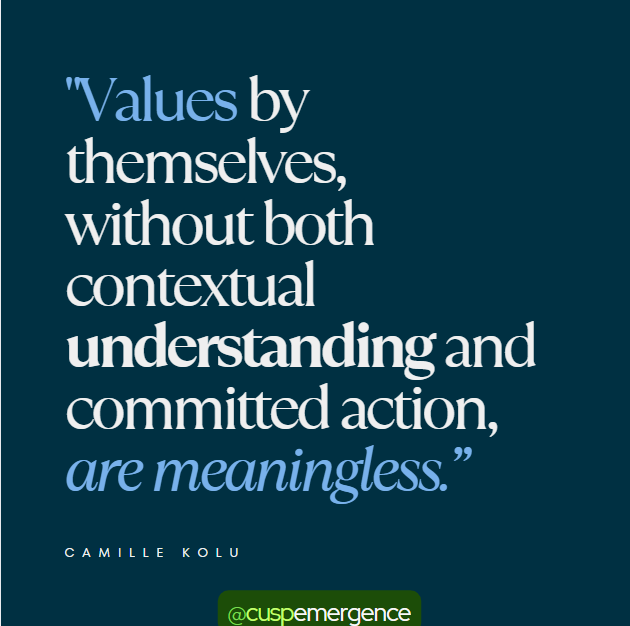
Why are values meaningless without contextual understanding, and committed action? And what’s the connection to Homer Simpson?

The question is found in both behavioral and permaculture applications. If you caught my talk at Stone Soup ABA 2024 sponsored by Lake Ridge Community Support Services, you heard a permaculture example (e.g., the seemingly value-based statement “if you value native plants, root out all invasive species”). This loosely parallels the concept of “just ignore junk behavior and reinforce what you DO want” in behavior analysis.

Is it always best to rip out non-native plants? For behaviorists, is it always appropriate to ignore and let “junk behavior” wither and die?

Maybe part of the problem is our misuse of the concept of “always”.

Now, I was fortunate to grow up with a witty, smart as a whip, biologist mom. She cared about the earth (more than my teen feelings of embarrassment, which I outgrew thanks to her bold example) and called out high school boys who littered right in front of her. She took us to Earth Day events even when we were one of the only families there (and, consequently, I WON the Earth Day Fishing Tournament, having been the ONLY entrant in my class). She wore the same Big Bend hat for decades, was a master gardener and a proud member of our local Native Plants Society, and championed native plants.

But she evolved with knowledge, like a true scientist does, and she would value the principles of permaculture that I’m learning about now.

Do we need to remove this thing, or understand it first?

For example, now we ask questions before we pull things out. Why is this plant here? Why does it grow, when almost nothing else is growing? What special features does it have that makes it thrive in a barren space of edges where the beautiful native plants we wish were here… AREN’T?

We appreciate the many interlocking functions of the thing we observe before us. What is it doing for the soil? Is it taking up space and time in an important way, holding the soil in place where it would have eroded due to habitat loss faced by the native plants leaving? Is it providing habitat for insects, birds, shade loving plants or others who need it?

If I say my value involves loving native plants but I mindlessly remove non-natives without considering THEIR roles too, I risk failing both natives and non-natives.

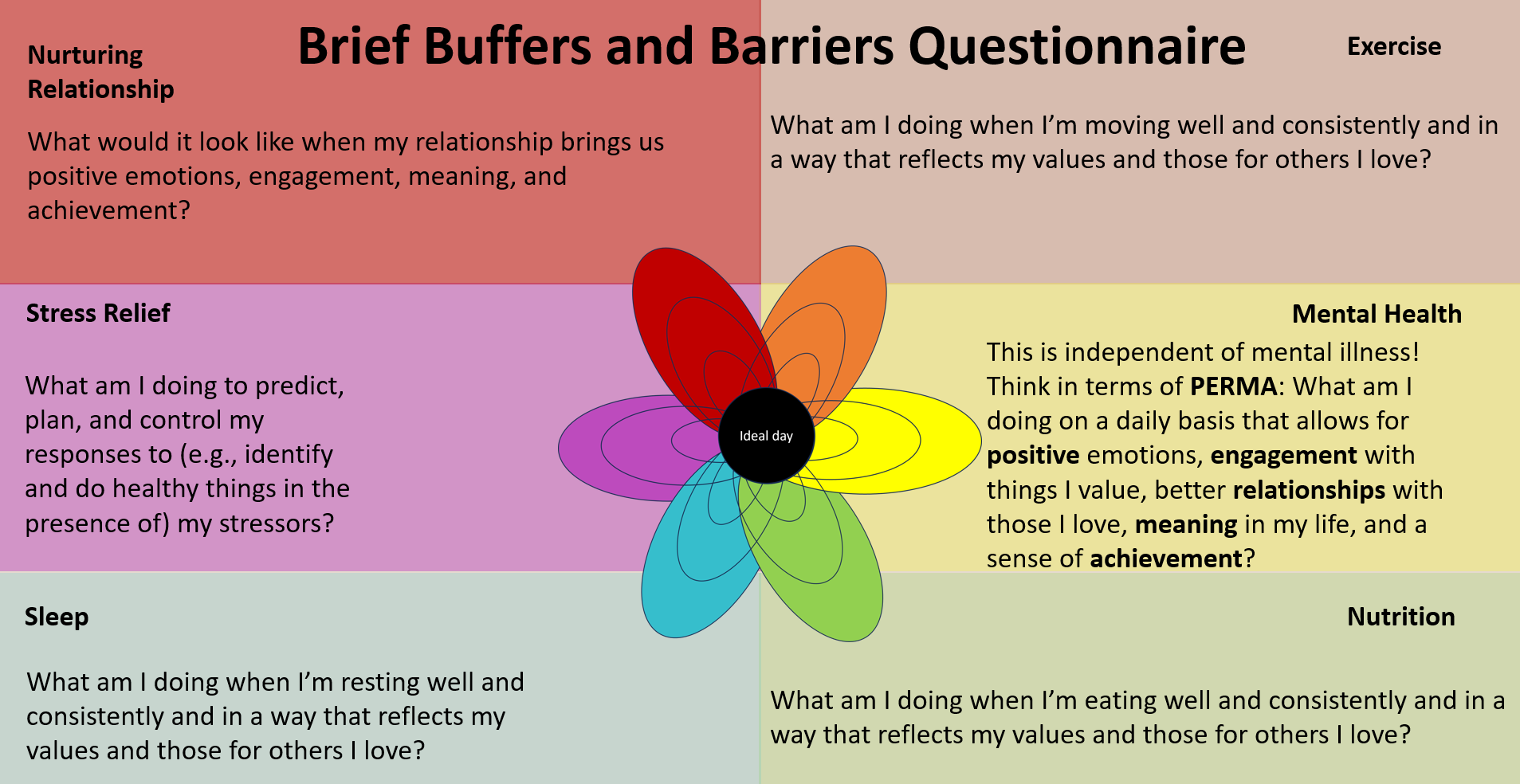
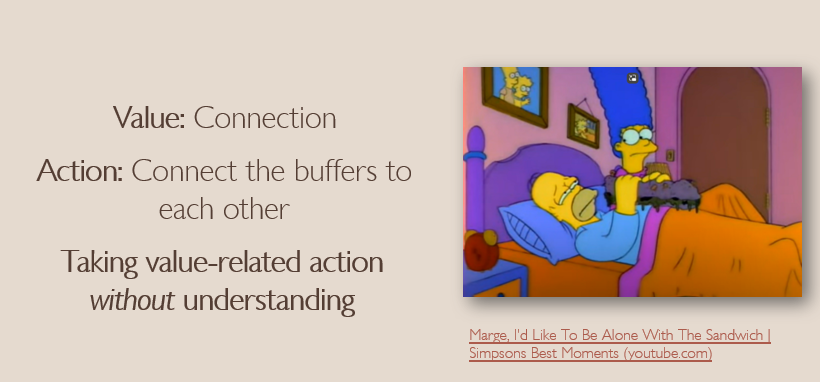
OK… what’s that got to do with Homer Simpson? Well, look. I want you all to be able to use the buffers. And one exercise I provide to teams or families new to them, is a little fun challenge: see how many you can use today. Why, go ahead and think about a single HOUR. How many can you use? For instance, Homer is… eating a sandwich (nutrition(ish) buffer)… while in bed… (sleep buffer?) with Marge (relationship buffer)… maybe this is helping his mental health and stress relief. Maybe they’re going to get in some exercise later this evening.

But here’s the thing. You need values, AND you need inter-relatedness among the buffers. We care about intentional connections, not simply combinations.

Homer’s always missed something. He loves Marge, but he often doesn’t think about her experience at all. He’s getting some buffers in, sure, but you know what happens almost immediately in this episode?

“Marge, I’d like to be alone with the sandwich for a moment.”

When we’re self-serving with our buffers, or mindlessly try to “get them all in” (or put them on someone else’s schedule when they haven’t provided their assent (see the BACB Ethics Code and its descriptions of it or learn more here) or even their INPUT), we’re not really embodying that value of fostering interconnected buffers.

Something I recommend is picking a buffer that guides your others… and anchoring committed actions to the OTHER buffers that reflect back that first one. (Interested in this? Work with or care about teens? Check out The Thriving Adolescent, for concrete suggestions and examples around selecting a value and identifying committed actions that reflect those.) For those of us in relationships, maybe it’s the idea that most of all, you want to value and protect the nurturing relationship. Then the other buffers can be designed around actions that reflect this. I know when I do this, I eat well because I’m making loving healthy meals for and with all my family members and we’re eating together. So, my nourishment is enmeshed with theirs and I’m no longer skipping meals, angrily lashing out because I’m hungry or protein deficient, or angry about having to come up with yet another meal idea. I could write a paragraph about each buffer and how it can all relate back to the nurturing relationship I want to foster with my close family members.

When Junk Isn’t Necessarily Junk

What does this have to do with junk behavior? Well, just like non-native plants wouldn’t be there if natives were all thriving. When the environment fosters the conditions which give rise to a healthy balance between plants, people, animals, insects, and the land, it works. And you can often think of many features of so-called “junk” that make it useful for someone else!

When something is rooted out… to make space for development, or there’s a huge loss of a predator, or an introduction of a new animal, etc… other things wander in. Before you trash them, notice them. Maybe they’re playing a role you need to notice, watch a while, understand.

When we change behavior with a plan, a transition, a death, whatever intentional or unintentional changes occur… other things wander in. So often we look only at how we can yank it OUT, without considering why it’s there, what purpose it’s serving. In the terms of buffers, is it temporarily helping someone to tolerate distress? To eat when there’s nothing else? To get rest or escape from their aversive environment? To take up space in their repertoire because there is a lack of meaningful things for them to do, see, say, hear, etc?

Someone wouldn’t use a whole lot of “junk behavior” if their needs were being met, they had tons of skills to communicate effectively, they had meaningful things to do all day and loving listeners to help them spend their time with purpose. (Look at this beautiful way to meet needs WITH “junk” instead of wasting it, and buying yet more building materials!)

The Next Step

Anyway, I hope you enjoy thinking about the buffers today and remembering it’s up to you to do all three: identify your values, understand your context, and design meaningful, committed actions that get you closer to those values. One step closer is enough today. Maybe your step is picking the buffer that most aligns with your core values and operationalizing that one right now! 😊

Ready to take Today’s Next Step? Pick ONE buffer below and operationalize it. That means, jot down what it would look like for you to engage in things that reflect your values in this area. What would you wake up and do, and do throughout the day, if your actions in this buffer area really reflected your values?

Need more info? Try taking the free (and jargon-free!) course on cuspemergenceuniversity.com, or dive a little deeper if you’re a behavior analyst by taking one of the others there.

Recent Posts

  • Lessons from a Lost Balloon: Growth, Safety, and Kindness
  • Behavioral Seismology
  • 10 Actions This Year: A call-in if you read Boggs et al. (2025)
  • Understanding Values: The Connection to Context and Action
  • I love you more than biscuits

Archives

  • July 2025
  • May 2025
  • November 2024
  • February 2024
  • June 2023
  • April 2023
  • March 2023
  • October 2022
  • February 2022
  • October 2021
  • August 2021
  • February 2021
  • September 2020
  • May 2020
  • March 2020
  • November 2019
  • September 2019
  • June 2019
  • January 2019
  • November 2018
  • October 2018
  • September 2018
  • July 2018
  • May 2018
  • April 2018
  • March 2018
  • February 2018
  • October 2017
  • September 2017
  • August 2017
  • July 2017
  • May 2016
  • September 2014
  • July 2013
  • June 2013
  • May 2013
  • April 2013
  • March 2013
  • February 2013
  • January 2013
  • December 2012
  • November 2012
  • October 2012
  • August 2012

Categories

  • About
  • acquisition
  • adults
  • Autism
  • BABA
  • BACB CEU
  • Behavior Analysis
  • behavior cusp
  • Behavioral Cusp
  • boundaries of competence
  • buffers and barriers
  • CASA
  • CEU
  • children
  • collaboration
  • Community
  • conferences
  • contextual fear conditioning
  • continuing education
  • contraindicated procedures
  • coronavirus
  • Court Appointed Special Advocate
  • Covid-19
  • Cusp Emergence University
  • CuspEmergenceUniversity
  • data
  • dementia
  • Early Intervention
  • edtiba
  • EDTIBA10
  • Education
  • Education and Trauma-Informed Behavior Analysis
  • elopement
  • Emergence
  • enriched environment
  • ethics
  • extinction
  • FAS
  • FASD
  • Fetal Alcohol Spectrum Disorders
  • flood
  • functional alternative behavior
  • hospital
  • hurricane
  • job aids
  • learning
  • mental health
  • Neuroscience
  • play
  • podcast
  • praise
  • RAD
  • reactive attachment disorder
  • renewal effect
  • resources
  • Rett's
  • risk analysis
  • risk assessment
  • risk versus benefit analysis
  • safety skills
  • sale
  • schedules of punishment
  • self injurious behavior
  • Social Interaction
  • stimulus schedules
  • supervision
  • teaching behavior analysis
  • teaching ethics
  • TI-ABA
  • TIABA
  • TIBA
  • trauma
  • trauma-informed behavior analysis
  • Uncategorized
  • variability

Meta

  • Create account
  • Log in
  • Entries feed
  • Comments feed
  • WordPress.com

Blog at WordPress.com.

  • Subscribe Subscribed
    • Cusp Emergence
    • Join 121 other subscribers
    • Already have a WordPress.com account? Log in now.
    • Cusp Emergence
    • Subscribe Subscribed
    • Sign up
    • Log in
    • Report this content
    • View site in Reader
    • Manage subscriptions
    • Collapse this bar
 

Loading Comments...