
Tags
ABA, ACT, assent, buffers, committed action, garden, gardening, nature, permaculture, values
Why are values meaningless without contextual understanding, and committed action? And what’s the connection to Homer Simpson?
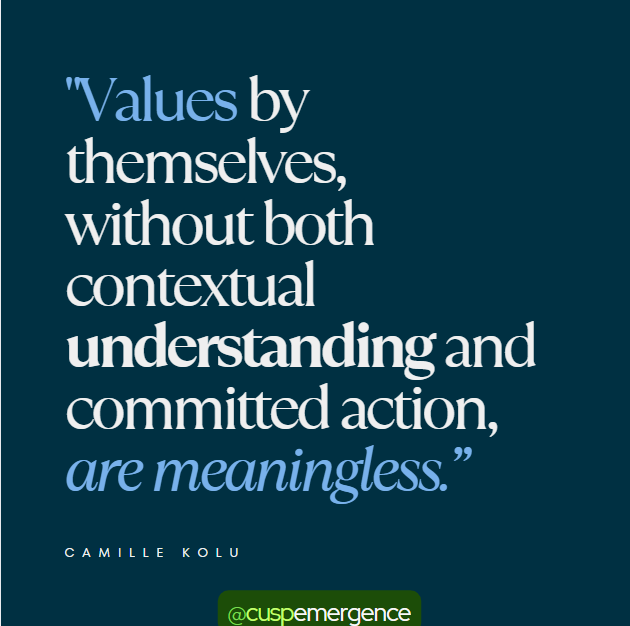
The question is found in both behavioral and permaculture applications. If you caught my talk at Stone Soup ABA 2024 sponsored by Lake Ridge Community Support Services, you heard a permaculture example (e.g., the seemingly value-based statement “if you value native plants, root out all invasive species”). This loosely parallels the concept of “just ignore junk behavior and reinforce what you DO want” in behavior analysis.
Is it always best to rip out non-native plants? For behaviorists, is it always appropriate to ignore and let “junk behavior” wither and die?
Maybe part of the problem is our misuse of the concept of “always”.
Now, I was fortunate to grow up with a witty, smart as a whip, biologist mom. She cared about the earth (more than my teen feelings of embarrassment, which I outgrew thanks to her bold example) and called out high school boys who littered right in front of her. She took us to Earth Day events even when we were one of the only families there (and, consequently, I WON the Earth Day Fishing Tournament, having been the ONLY entrant in my class). She wore the same Big Bend hat for decades, was a master gardener and a proud member of our local Native Plants Society, and championed native plants.
But she evolved with knowledge, like a true scientist does, and she would value the principles of permaculture that I’m learning about now.
Do we need to remove this thing, or understand it first?
For example, now we ask questions before we pull things out. Why is this plant here? Why does it grow, when almost nothing else is growing? What special features does it have that makes it thrive in a barren space of edges where the beautiful native plants we wish were here… AREN’T?
We appreciate the many interlocking functions of the thing we observe before us. What is it doing for the soil? Is it taking up space and time in an important way, holding the soil in place where it would have eroded due to habitat loss faced by the native plants leaving? Is it providing habitat for insects, birds, shade loving plants or others who need it?
If I say my value involves loving native plants but I mindlessly remove non-natives without considering THEIR roles too, I risk failing both natives and non-natives.
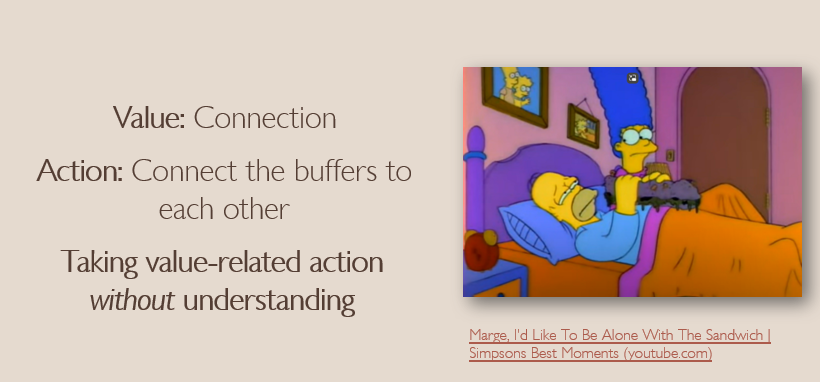
OK… what’s that got to do with Homer Simpson? Well, look. I want you all to be able to use the buffers. And one exercise I provide to teams or families new to them, is a little fun challenge: see how many you can use today. Why, go ahead and think about a single HOUR. How many can you use? For instance, Homer is… eating a sandwich (nutrition(ish) buffer)… while in bed… (sleep buffer?) with Marge (relationship buffer)… maybe this is helping his mental health and stress relief. Maybe they’re going to get in some exercise later this evening.
But here’s the thing. You need values, AND you need inter-relatedness among the buffers. We care about intentional connections, not simply combinations.
Homer’s always missed something. He loves Marge, but he often doesn’t think about her experience at all. He’s getting some buffers in, sure, but you know what happens almost immediately in this episode?
“Marge, I’d like to be alone with the sandwich for a moment.”
When we’re self-serving with our buffers, or mindlessly try to “get them all in” (or put them on someone else’s schedule when they haven’t provided their assent (see the BACB Ethics Code and its descriptions of it or learn more here) or even their INPUT), we’re not really embodying that value of fostering interconnected buffers.
Something I recommend is picking a buffer that guides your others… and anchoring committed actions to the OTHER buffers that reflect back that first one. (Interested in this? Work with or care about teens? Check out The Thriving Adolescent, for concrete suggestions and examples around selecting a value and identifying committed actions that reflect those.) For those of us in relationships, maybe it’s the idea that most of all, you want to value and protect the nurturing relationship. Then the other buffers can be designed around actions that reflect this. I know when I do this, I eat well because I’m making loving healthy meals for and with all my family members and we’re eating together. So, my nourishment is enmeshed with theirs and I’m no longer skipping meals, angrily lashing out because I’m hungry or protein deficient, or angry about having to come up with yet another meal idea. I could write a paragraph about each buffer and how it can all relate back to the nurturing relationship I want to foster with my close family members.
When Junk Isn’t Necessarily Junk

What does this have to do with junk behavior? Well, just like non-native plants wouldn’t be there if natives were all thriving. When the environment fosters the conditions which give rise to a healthy balance between plants, people, animals, insects, and the land, it works. And you can often think of many features of so-called “junk” that make it useful for someone else!
When something is rooted out… to make space for development, or there’s a huge loss of a predator, or an introduction of a new animal, etc… other things wander in. Before you trash them, notice them. Maybe they’re playing a role you need to notice, watch a while, understand.
When we change behavior with a plan, a transition, a death, whatever intentional or unintentional changes occur… other things wander in. So often we look only at how we can yank it OUT, without considering why it’s there, what purpose it’s serving. In the terms of buffers, is it temporarily helping someone to tolerate distress? To eat when there’s nothing else? To get rest or escape from their aversive environment? To take up space in their repertoire because there is a lack of meaningful things for them to do, see, say, hear, etc?

Someone wouldn’t use a whole lot of “junk behavior” if their needs were being met, they had tons of skills to communicate effectively, they had meaningful things to do all day and loving listeners to help them spend their time with purpose. (Look at this beautiful way to meet needs WITH “junk” instead of wasting it, and buying yet more building materials!)

The Next Step
Anyway, I hope you enjoy thinking about the buffers today and remembering it’s up to you to do all three: identify your values, understand your context, and design meaningful, committed actions that get you closer to those values. One step closer is enough today. Maybe your step is picking the buffer that most aligns with your core values and operationalizing that one right now! 😊
Ready to take Today’s Next Step? Pick ONE buffer below and operationalize it. That means, jot down what it would look like for you to engage in things that reflect your values in this area. What would you wake up and do, and do throughout the day, if your actions in this buffer area really reflected your values?
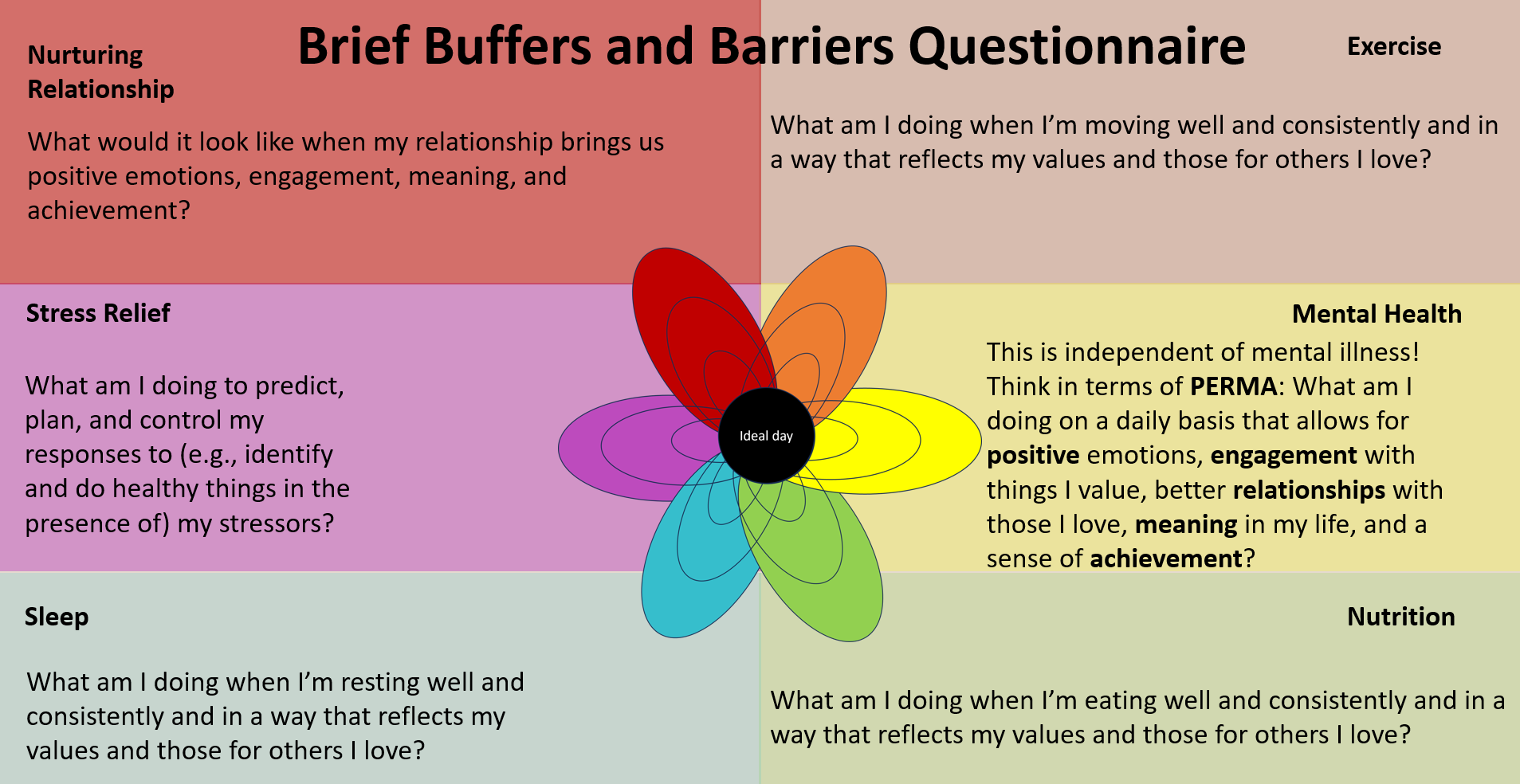
Need more info? Try taking the free (and jargon-free!) course on cuspemergenceuniversity.com, or dive a little deeper if you’re a behavior analyst by taking one of the others there.
 Cusp Emergence